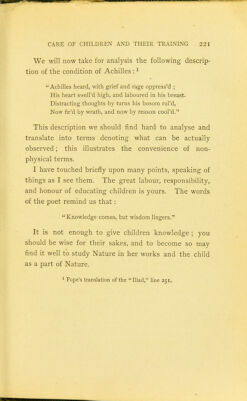
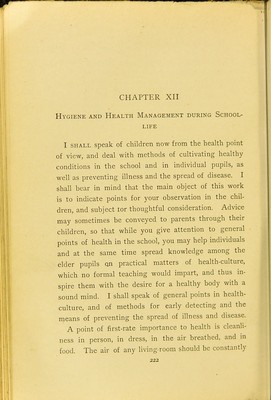
The study of children and their school training / by Francis Warner.
- Francis Warner
- Date:
- 1902
Licence: In copyright
Credit: The study of children and their school training / by Francis Warner. Source: Wellcome Collection.
Provider: This material has been provided by King’s College London. The original may be consulted at King’s College London.
242/296 page 218
![depends much upon the teacher whether the object lesson shall teach thinking or only observing. Im- pressions produced by sight of the specimen may be followed, after it is removed, by thoughts; descrip- tions given by the pupil are expressions of thought, and help to enlarge his vocabulary. Suppose you take some simple leaves not notched upon the margin, and speak of them with regard to their shape. You may describe them as oval, elliptical, ovate, obovate, lanceolate, etc., using a new term for every shape, that is, using a number of terms, one for every shape or ratio in the length of the transverse and median axis ; in place of this you may indicate the ratio; say, let us consider the form as determined by the ratios of the axes, and do without a long nomenclature. (oval) median axis . . length 3 ) the axes crossing at their transverse axis . . . li centres at right angles. 4 ■» the axes crossmg at their I ) centres at right angles. 31 the axes crossing at right I ) angles ^ from the base. 3 ] the axes crossing at right I j angles | from the base. It is unnecessary to go further into details. As to these two modes of describing form of leaves, the second indicates what you observe on looking at the leaf There is a great difference between teachmg science and scientific teaching. Let me give another transverse axis (elliptical) median axis . transverse axis (ovate) median axis . . transverse axis . (obovate) median axis . transverse axis](https://iiif.wellcomecollection.org/image/b21294987_0242.jp2/full/800%2C/0/default.jpg)