Researches on the constitution of physostigmine. Pt. I[-II] / by Arthur H. Salway.
- Salway, Arthur Henry.
- Date:
- 1912-1913
Licence: In copyright
Credit: Researches on the constitution of physostigmine. Pt. I[-II] / by Arthur H. Salway. Source: Wellcome Collection.
Provider: This material has been provided by The Royal College of Surgeons of England. The original may be consulted at The Royal College of Surgeons of England.
12/32 page 985
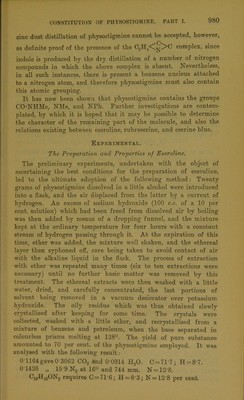
![benzene of crystallisation. It dissolves in concentrated sulphuric acid with a yellow colour, which becomes red on the addition of water. The aqueous solution of rubreserine is readily decolorised by reducing agents such as hydrogen sulphide, but the red colour reappears on removing the latter by a current of air. When anhydrous rubreserine is heated for a few hours at 115°, the colour changes from red to brown, and finally becomes quite black without alteration in weight. The product does not melt below 300°, and is undoubtedly a polymerised form of rubreserine. Rubreserine is neutral in reaction towards litmus, but it possesses both basic and acidic properties. Its basic properties were proved by the forma- tion of a hydrochloride, picrate, and aurichloride respectively. Rubreserine Hydrochloride.—This substance was prepared by passing dry hydrogen chloride into a solution of rubreserine in ethyl acetate containing a little alcohol. A dull red, crystalline precipitate was thus obtained, which melted and decomposed at 185°: 0-0992, heated at 110°, lost 0'0070 H20. H20 = 7T. Cj3Hj702N2C1,II20 requires H20 = 63 per cent. 0-0912* gave 0T942 C02 and 0’0558 H,0. C = 581; H = 6‘8. C13H1702N2C1 requires C = 58T; H = 6'3 per cent. Rubreserine picrate crystallises from dilute alcohol in brick-red leaflets, which begin to change at 186°, and completely decompose at 198°. Rubreserine Aurichloride.—This substance separates from a solution of rubreserine in hydrochloric acid, to which gold chloride had been added, in bright red needles, which decompose at 190—195°: 0-1710 gave 0-1705 C02, 0 0442 H,0, jyid 0'0595 Au. C = 27'2; H = 2‘9; Au = 34'8. Ci3H1702N2,AuC14 requires 0 = 273; H = 30; Au = 344 per cent. It is evident from the examination of the above salts that rubreserine, like physostigmine and eseroline, contains only one basic nitrogen atom. The acidic properties of rubreserine were indicated by the forma- tion of a silver salt; thus, when silver nitrate was added to an aqueous solution of rubreserine, the silver salt of rubreserine nitrate separated in dull red needles, which possess a bronze-like lustre: 0-0819 gave 0T170 C02, 0 0316 H^O, and 0'0221 Ag. C = 39 0; H=4-3; Ag = 27-0.“ C]3H1602N2,AgN03 requires C=38'8; H = 40; Ag = 269 per cent. Further evidence of the acidic character of rubreserine was * Anhydrous substance.](https://iiif.wellcomecollection.org/image/b2243933x_0012.jp2/full/800%2C/0/default.jpg)


 No text description is available for this image
 No text description is available for this image
 No text description is available for this image