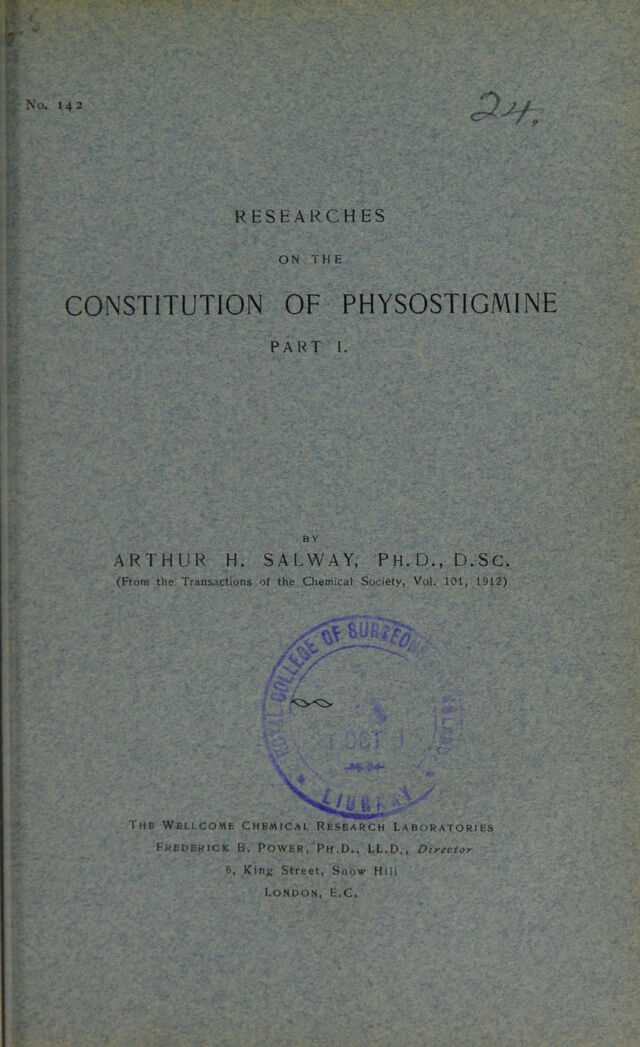
Researches on the constitution of physostigmine. Pt. I[-II] / by Arthur H. Salway.
- Salway, Arthur Henry.
- Date:
- 1912-1913
Licence: In copyright
Credit: Researches on the constitution of physostigmine. Pt. I[-II] / by Arthur H. Salway. Source: Wellcome Collection.
Provider: This material has been provided by The Royal College of Surgeons of England. The original may be consulted at The Royal College of Surgeons of England.
27/32 page 359
![base was precipitated as a colourless oil. This was dissolved in ether, the ethereal solution dried, and the solvent removed. The residual oil slowly solidified, and was then purified by crystallisa- tion from light petroleum, when it separated in radiating clusters of colourless, prismatic needles, melting at 54°: 0T265 gave 0'3376 C02 and 0'0898 H20. C = 72 8; H 7 9. C19H2402N2 requires C=73T; H = 7’7 per cent. a-Dimethylamino-y-phenoxybutyro-o-toluidide is very readily soluble in the usual organic solvents, and can only be crystallised with difficulty. It is a weak base, forming salts which are acid towards litmus, and also possess an extremely bitter taste. The hydrochloride, prepared by passing a current of dry hydrogen chloride into an ethereal solution of the base, crystallises from a mixture of alcohol and ethyl acetate in slender, colourless needles, melting at 169°: 0-1010 gave 0-2410 C02 and 0'0646 H20. C = 65T ; H = 7T. C]9H2402N2,HC1 requires C = 65'4; H = 7‘2 per cent. The platinichloride of the above base crystallises from alcohol, containing a little hydrochloric acid, in small, brown prisms, melting at 215°. 2-a-Dim ethylamino-y-hydro xypropylindole. In order to prepare this compound 0‘3 gram of sodium was dissolved in absolute alcohol in a capacious flask, and the alcohol removed under diminished pressure; to the sodium ethoxide thus obtained, 2 grams of a-dimethylamino-y-phenoxybutyro-o-toluidide were added, and the mixture heated in a metal bath to a tempera- ture of 250—300° in a current of hydrogen. At this temperature reaction took place with effervescence and a considerable darkening in colour, and the process was soon complete. The entire operation was repeated four times with the same quantities of material, and the products from the several reactions were then united and acidified with dilute hydrochloric acid. The acid liquid was next shaken with ether, which removed a considerable quantity of phenol, identified by means of its tribromo-derivative, then made alkaline with sodium carbonate, and the mixture repeatedly- extracted with chloroform. The chloroform extracts were washed, dried, and the solvent removed, when an oily, basic residue was obtained, which did not crystallise on keeping. For its purification it was dissolved in dilute hydrochloric acid, the solution evaporated to dryness under diminished pressure, and the solid residue thus obtained crystallised from a mixture of alcohol and ethyl acetate. The hydrochloride of the base then separated in colourless, prismatic](https://iiif.wellcomecollection.org/image/b2243933x_0027.jp2/full/800%2C/0/default.jpg)