Text-book for students of chemistry. Containing a condensed view of the facts and the principles of the science / [D.B. Reid].
- David Boswell Reid
- Date:
- 1836
Licence: Public Domain Mark
Credit: Text-book for students of chemistry. Containing a condensed view of the facts and the principles of the science / [D.B. Reid]. Source: Wellcome Collection.
7/216
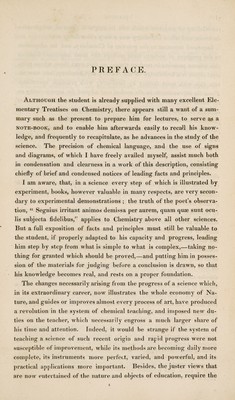
![PREFACE. Although the student is already supplied with many excellent Ele¬ mentary Treatises on Chemistry, there appears still a want of a sum¬ mary such as the present to prepare him for lectures, to serve as a NOTE-BOOK, and to enable him afterwards easily to recall his know¬ ledge, and frequently to recapitulate, as he advances in the study of the science. The precision of chemical language, and the use of signs and diagrams, of which I have freely availed myself, assist much both in condensation and clearness in a work of this description, consisting chiefly of brief and condensed notices of leading facts and principles. I am aware, that, in a science every step of which is illustrated by experiment, books, however valuable in many respects, are very secon¬ dary to experimental demonstrations ; the truth of the poet’s observa¬ tion, “ Segnius irritant animos demissa per aurem, quam quad sunt ocu- lis subjecta fidelibus,” applies to Chemistry above all other sciences. But a full exposition of facts and principles must still be valuable to the student, if properly adapted to his capacity and progress, leading him step by step from what is simple to what is complex,—taking no¬ thing for granted which should be proved,—and putting him in posses¬ sion of the materials for judging before a conclusion is drawn, so that ' his knowledge becomes real, and rests on a proper foundation. The changes necessarily arising from the progress of a science which, in its extraordinary career, now illustrates the whole economy of Na¬ ture, and guides or improves almost every process of art, have produced a revolution in the system of chemical teaching, and imposed new du¬ ties on the teacher, which necessarily engross a much larger share of his time and attention. Indeed, it would be strange if tlie system of teaching a science of such recent origin and rapid progress were not susceptible of improvement, while its methods ai’e becoming daily more complete, its instruments more perfect, varied, and powerful, and its ])ractical ap[(lications more important. Besides, the juster views that are now entertained of the nature and objects of education, require the](https://iiif.wellcomecollection.org/image/b2929289x_0007.jp2/full/800%2C/0/default.jpg)


 No text description is available for this image
 No text description is available for this image
 No text description is available for this image