On the postfebrile ophthalmitis / by Andrew Anderson.
- Anderson, Andrew, 1818-1870.
- Date:
- 1845
Licence: Public Domain Mark
Credit: On the postfebrile ophthalmitis / by Andrew Anderson. Source: Wellcome Collection.
Provider: This material has been provided by The University of Glasgow Library. The original may be consulted at The University of Glasgow Library.
21/52
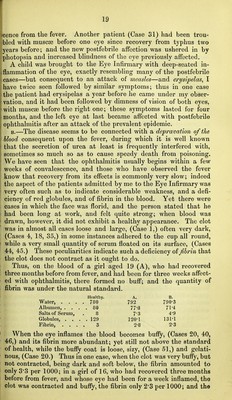
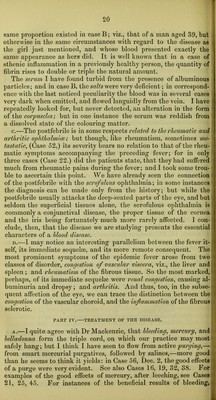
![bably according to the varying state of congestion of the retina. One man, (Case 36,) who had regained perfectly clear vision after the subsidence of the inflammation, complained that the muscae al- ways returned when the circulation was quickened by exertion; an- other patient, that they came back when he was costive, (Case 44). Vision is sometimes variable even during the inflammatory stage, (Case 44), but more usually during convalescence,—the patient being able to see best in the morning (Case 32) or in the evening. B.—Intolerance of light was rather rare, being remarkable in only five cases, and in two of these there was a complication with oph- thalmia scrofulosa. In the case in which the adjustment of the eye to near objects caused pain, there was no intolerance,—a proof, I think, if one were needed, that irritation of the ciliary body, (cilitis), which we have seen as the probable cause of asthenopia, has no connexion with photophobia, as Berard (An. d'Oculistique, 1844) has supposed it to have. In no case did intolerance coin- cide with very severe inflammation; and once, while the deeply seated tissues were involved, there was even what might be called the reverse of photophobia, the patient requiring a strong light to enable him to distinguish objects. c.—Pyropsia^ or the appearance as of sparks and flashes of fire before the eye, occurred to me in thirteen cases. In two (Case 25) of these it was the earliest symptom, and preceded the amaurosis by a week; in another, it followed muscae, and was accompanied by increased dimness of vision, but preceded by some time the in- flammatory attack: in this instance the flashes of light were seen only in the dark. In four cases (Cases 26, 35,) the photopsia ac- companied the inflammatory stage; and in five (Cases 2, 3,) it oc- curred for the first time when the eye was getting well under treat- ment,—the luminous flashes being by two of these patients per- ceived only when the eye was moved or opened. In all these in- stances there must have been more or less irritation of the retina, and not the mere congestion that seems usually to exist. D. —Ghroopsia^ or coloured vision, I met with four times. One patient stated that he saw everything of a green colour; another, (Case ]), that a green haze seemed to hang constantly before the eye. This floating mist was red in Cases 27 and 47; in Cases 26 and 40, the muscae which hung before the eye had a blueish green hue; in Case 48 flashes of purple light were frequently perceived, be- coming yellow as the symptoms yielded to treatment; and lastly, in one instance purple muscae were complained of after convales- cence. E. —A deficiency in the power of distinguishing colours is stated -by Dr Jacob to have been one of the symptoms observed by him in the post-febrile ophthalmia,—blue and green being confounded, he says, with black. I have carefully examined this point, and conclude that there is no inability to distinguish colours, other than what necessarily results from the indistinctness of vision:](https://iiif.wellcomecollection.org/image/b21451801_0021.jp2/full/800%2C/0/default.jpg)