The Schola salernitana : its history and the date of its introduction into the British Isles / by Norman Moore.
- Sir Norman Moore, 1st Baronet
- Date:
- 1908
Licence: Public Domain Mark
Credit: The Schola salernitana : its history and the date of its introduction into the British Isles / by Norman Moore. Source: Wellcome Collection.
Provider: This material has been provided by the Francis A. Countway Library of Medicine, through the Medical Heritage Library. The original may be consulted at the Francis A. Countway Library of Medicine, Harvard Medical School.
26/80 page 18
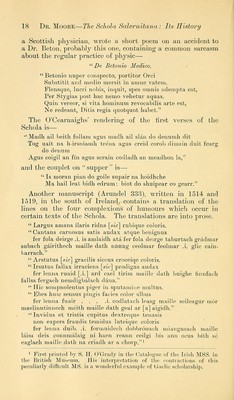
![a Scottish physician, wrote a short poem on an accident to a Dr. Beton, probably this one, containing a common sarcasm about the regular practice of physic— De Betonio Medico. Betonio nuper conspecto, portitor Orci Substitit and medio mersit in amne vateoi. Flensque, lucri nobis, inquit, spes omnis adempta est, Per Stygias post hac nemo vehetur aquas. Quin vereor, si vita hominum revocabilis arte est, Ne redeant, Ditis regia quotquot habet. The O'Cearnaighs' rendering of the first verses of the Schola is— '' Madh ail beith follam agus madh ail slan do denumh dit Tog uait na h-irsniamh treiia agus creid corob diuiaiu duit fearg do deiium Agus coigil an fin agus scrain codladh an meadhon la, and the couplet on supper is— Is moran pian do goile supair na hoidhche Ma hail leat bidh edrum: biot do shuipear co gearr. Another manuscript (Arundel 338), written in 1514 and 1519, in the south of Ireland, contains a translation of the lines on the four complexions of humours which occur in certain texts of the Schola. The translations are into prose. Largus amans ilaris ridns \sic\ rubique coloris. Cantans carnosus satis audax atque benignus fer fola deirge .i. is amlaidh ata fer fola deirge taburtach gradmar subach gairithech maille dath noERg ceolraar feolmar .i. glic cain- harrach. Arstutus \sic\ gracilis siccus croceiqe coloris. Irsutus fallax irraciens \sic\ prodigus audax fer lenna ruaid [.i.J ard cael tirim maille dath buighe tinnfach fallsa fergach neradigbalach dana. Hie sompnolentus piger in sputamine niultus. Ebes huic sensus pingis facias color albus fer lenna fuair ... .i. codlatach leasg maille seileagur mur maelinntinnech meith maille dath geal ar [a] aigidh. Invidus et tristis cupitus dextreque tenasis non exjDers fraud is temidus luteique coloris fer lenna duib. .i. formuidech dobbronach miangusach maille laim deis connmalaig ni haen reann ceilgi bis ann ocus bith so eaglach maille dath na criadh ar a chorp.i 1 First printed by S. H. O'Grady in the Catalogue of the Irish MSS. in the British Museum. His interpretation of tiie contractions of this peculiarly dithcult MS. is a wonderful example of Gaelic scholarship.](https://iiif.wellcomecollection.org/image/b21170332_0026.jp2/full/800%2C/0/default.jpg)


 No text description is available for this image
 No text description is available for this image
 No text description is available for this image