A journal of the plague year, or, Memorials of the great pestilence in London, in 1665 / by Daniel De Foe. Revised edition with historical notes by E. W. Brayley ... Also, some account of the great fire in London in 1666, by Gideon Harvey ... with an appendix containing the Earl of Clarendon's account of the fire. With illustrations on steel by George Cruikshank.
- Daniel Defoe
- Date:
- [1881]
Licence: Public Domain Mark
Credit: A journal of the plague year, or, Memorials of the great pestilence in London, in 1665 / by Daniel De Foe. Revised edition with historical notes by E. W. Brayley ... Also, some account of the great fire in London in 1666, by Gideon Harvey ... with an appendix containing the Earl of Clarendon's account of the fire. With illustrations on steel by George Cruikshank. Source: Wellcome Collection.
Provider: This material has been provided by the Augustus C. Long Health Sciences Library at Columbia University and Columbia University Libraries/Information Services, through the Medical Heritage Library. The original may be consulted at the the Augustus C. Long Health Sciences Library at Columbia University and Columbia University.
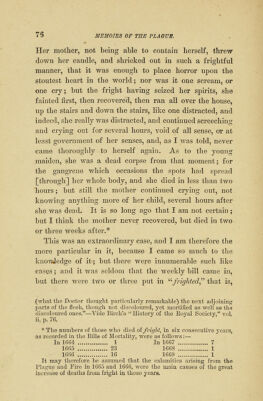
![Her mother, not being able to contain berself, threw down her candle, and shrieked out in such a frightful manner, that it was enough to place horror upon the stoutest heart in the world; nor was it one scream, or one cry; but the fright having seized her spirits, she fainted first, then recovered, then ran all over the house, up the stairs and down the stairs, like one distracted, and indeed, she really was distracted, and continued screeching and crying out for several hours, void of all sense, or at least government of her senses, and, as I was told, never came thoroughly to herself again. As to the young maiden, she was a dead corpse from that moment; for the gangrene which occasions the spots had spread [through] her whole body, and she died in less than two hours; but still the mother continued ci-ying out, not knowing anything more of her child, several hours after she was dead. It is so long ago that I am not certain; but I think the mother never recovered, but died in two or three weeks after.* This was an extraordinary case, and I am therefore the more particular in it, because I came so much to the kuoTvdedge of it; but there were innumerable such like cases; and it was seldom that the weekly bill came in, but there were two or three put in ^'■frighted that is, (wliat the Doctor thouglit particularly remarkable) the next adjoining parts of the flesh, though not discoloui'ed, yet mortified as well as tha discoloured ones.—Vide Bii-ch's History of the Eoyal Society, voL ii, p. 76. * The numbers of those who died ot fright, in six consecutive years, as recorded in the Bills of Mortality, were as follows :— InlG64: 1 In 1667 7 1665 23 1668 1 1666 16 1669 1 It may therefore be assumed that the calamities arising from the Plague and Fire in 1665 and 1666, were the main cavises of the great increase of deaths from fright in those years.](https://iiif.wellcomecollection.org/image/b21224377_0106.jp2/full/800%2C/0/default.jpg)