A journal of the plague year, or, Memorials of the great pestilence in London, in 1665 / by Daniel De Foe. Revised edition with historical notes by E. W. Brayley ... Also, some account of the great fire in London in 1666, by Gideon Harvey ... with an appendix containing the Earl of Clarendon's account of the fire. With illustrations on steel by George Cruikshank.
- Daniel Defoe
- Date:
- [1881]
Licence: Public Domain Mark
Credit: A journal of the plague year, or, Memorials of the great pestilence in London, in 1665 / by Daniel De Foe. Revised edition with historical notes by E. W. Brayley ... Also, some account of the great fire in London in 1666, by Gideon Harvey ... with an appendix containing the Earl of Clarendon's account of the fire. With illustrations on steel by George Cruikshank. Source: Wellcome Collection.
Provider: This material has been provided by the Augustus C. Long Health Sciences Library at Columbia University and Columbia University Libraries/Information Services, through the Medical Heritage Library. The original may be consulted at the the Augustus C. Long Health Sciences Library at Columbia University and Columbia University.
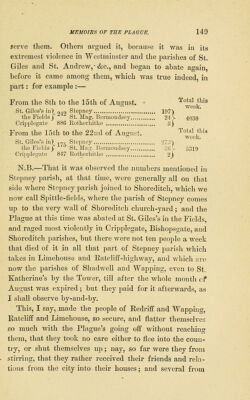
![their assistants, that is to say, bearers, bellmen, and di'ivers of carts for carrying off the dead bodies.* Indeed the work was not of a nature to allow them leisure to take an exact tale of the dead bodies, which were aU huddled together in the dark into a pit; which pit or trench no man could come nigh but at the utmost peril. I observed often, that in the parishes of Aldgate and Cripplegate, Whitechapel, and Stepney, there Avere five, six, seven, and eight hundred in a week in the biUs ; whereas, if we may believe the opinion of those that lived in the city all the time, as well as I, there died sometimes 2000 a week in those parishes; and I saw it under the hand of one that made as strict an examination into that part as he could, that there really died an hundred thous- and people of the Plague in it [London] that one year, whereas, in the bills, the articles of the Plague formed but 68,590. If r may be allowed to give my opinion, by what I saAV with my eyes, and heard from other people that were eye-witnesses, I do verily believe the same, viz., that there died, at least, 100,000 of the Plague only, besides other distempers, and besides those which died in the fields and highways, and secret places, out of the compass of the communication, as it was called, and who were not put down in the bills, though they really belonged to the body of the inhabitants.! It was known * It appears from the parish register of Stepney, that 154 persons were buried there in the Plag-ue-year in one day, on September the lltli. Prom the great numbers wliich died of the Plague, a large piece of ground on the north side of Mile-end Koad, near the Dog-row, was appropriated for a burial-place. It was afterwards converted into a nursery garden, and remained so until the beginning of the present century. ■ t Lord Clarendon says, that The frequent deaths of the Clerks and Sextons of Parishes, hindered the esact account of every iveek; but that which left it without any certainty, was the vast number that was](https://iiif.wellcomecollection.org/image/b21224377_0163.jp2/full/800%2C/0/default.jpg)