A course of lectures on physiology / as delivered by Prof. Küss at the Medical School of the University of Strasbourg ; edited by Mathias Duval ; translated from the 2nd rev. ed. by Robert Amory.
- Küss, Émile, 1815-1871.
- Date:
- 1876
Licence: Public Domain Mark
Credit: A course of lectures on physiology / as delivered by Prof. Küss at the Medical School of the University of Strasbourg ; edited by Mathias Duval ; translated from the 2nd rev. ed. by Robert Amory. Source: Wellcome Collection.
Provider: This material has been provided by University of Bristol Library. The original may be consulted at University of Bristol Library.
121/588 page 101
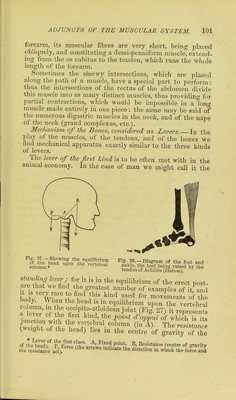
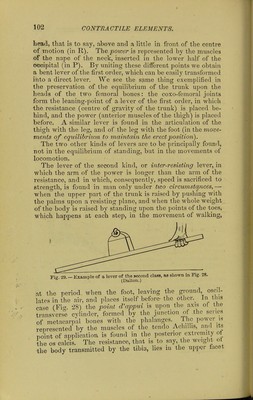
![forearm, its muscular fibres are very short, being placed obliquely, and constituting a demi-penniform muscle, extend- ing from the os cubitus to the tendon, which runs the whole length of the forearm. Sometimes the sinewy intersections, which are placed along the path of a muscle, have a special part to perform : thus the intersections of the rectus of the abdomen divide this muscle into as many distinct muscles, thus providing for partial contractions, which would be impossible in a lon» muscle made entirely in one piece; the same may be said o? the numerous digastric muscles in the neck, and of the nape of the neck (grand complexus, etc.). Mechanism of the Bones, considered as Levers. In the play of the muscles, of the tendons, and of the bones we find mechanical apparatus exactly similar to the three kinds of levers. The lever of the first kind is to be often met with in the annual economy. In the case of man we might call it the Fig. 2T. —Showing the equiHbrlum of the head upon the vertebral column.* Fig. 28.-.D agram of the foot and ankle, the heel being raised by the tendon of Achilles (Dalton). standing lever; for it is in the equilibrium of the erect post- ure that we find the greatest number of examples of t,^and bo?vml%t\^''-^'°^-V-?^ —ents of the body. When the head is m equilibrium upon the vertebral a lev'er' of ^^^^1'^^^ ^^^^^ (^^^ ^') it^-sent a level of the first kind, the point d'appici of which is its (weight of the bead) lies m the centre of gravity of the oi*i\7Zfv^tr!:J']f^^' point- R; Resistance (centre of ffravitv the resSce act> '^'^'^ ^^«^«on in which the fo^eS](https://iiif.wellcomecollection.org/image/b21443944_0121.jp2/full/800%2C/0/default.jpg)
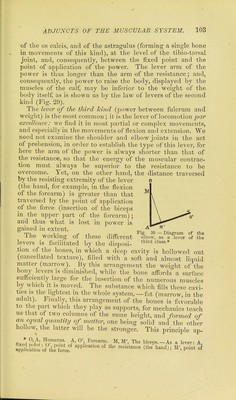
 No text description is available for this image
 No text description is available for this image
 No text description is available for this image