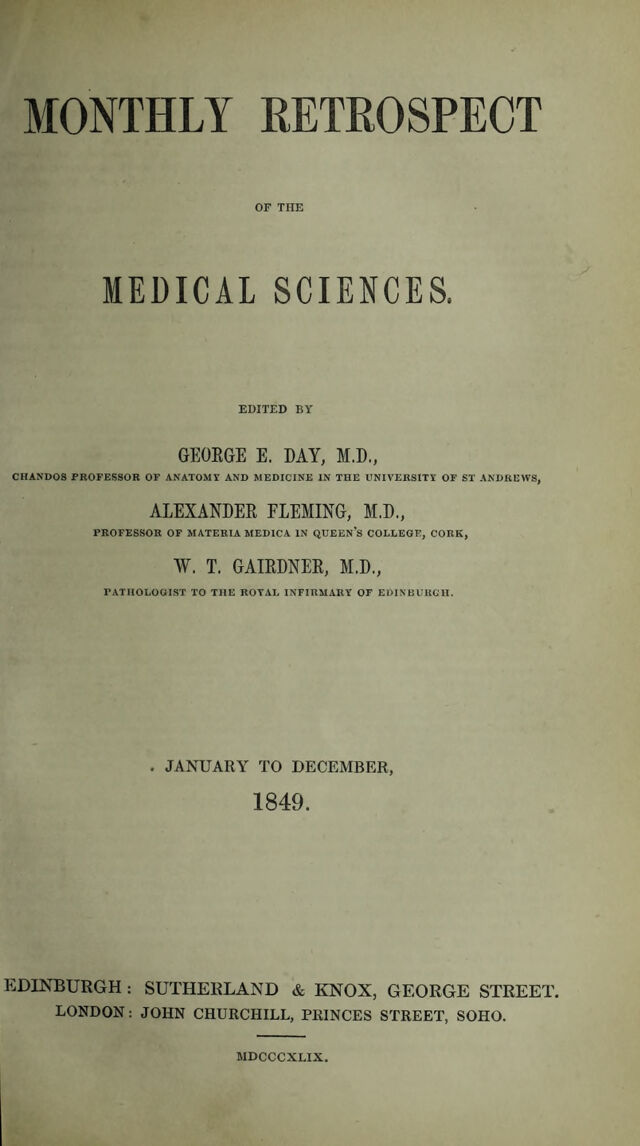
Monthly retrospect of the medical sciences : January to December 1849 / edited by George E. Day, Alexander Fleming, W.T. Gairdner.
- Date:
- MDCCCXLIX [1849]
Licence: Public Domain Mark
Credit: Monthly retrospect of the medical sciences : January to December 1849 / edited by George E. Day, Alexander Fleming, W.T. Gairdner. Source: Wellcome Collection.
53/262 page 51
![EXPEKIMENT II. S. G. bottle contained— Grs. of Distilled Water at C0° 105-73 of Serum No. 1 at do. 108-32 of Serum No. 2 at do. 108-32 of Serum No. 3 at do. 108-31 The density of 1 and 2 was con- sequently . . . 1024-49 .of3 . , , 10-24-40 The difference '09 (equivalent to about •3 of a grain of solids in 1000 serum) was in favour of the earlier samples, and may be accounted for by some trifling error in manipulation. As it may be assumed that the solid contents of serum bear a direct ratio to its specific gravity, we con¬ clude that Andral and Gavarret’s process might have been applied in this case with¬ out fear of error.], 72.—On the Pathology of the Muguet or True Thrush of Children. By Dr WiLLSHiKE (Medical Society of London). —It is now well known that Gruby, Berg, and other observers, have ascer¬ tained that the curdy matter which is deposited in the mucous membrane of the mouth and oesophagus of children in this disease is a vegetable organism, possess¬ ing a microscopic structure very similar to the lower orders of fungi. Dr Willshire corroborates this fact from his own ob¬ servation, but is disposed to view the pre¬ sence of the parasite, not as the cause of the disease, but as the effect of an exuda¬ tion previously thrown out, and therefore only a contingent or secondary pheno¬ menon, dependent upon the laws regulat¬ ing the decomposition of the exuded mat¬ ter. He thinks that the exuded matter, loaded with the materials of the child’s aliment, passes partially into a species of decomposition, analogous to fermenta¬ tion, and gives rise, as in the latter pro¬ cess, to a vegetable growth.—Med. Gaz., Feb. 2, 1849. [The author alludes to the experiments of Gruby, tending to prove that the dis¬ eases depending on vegetable parasites cannot be inoculated ; but he does not appear to be aware of the experiments of Dr Hughes Bennett, in which direct inoculation of the tinea favosa was pro¬ duced.] 73. —On the quick Absorption of Virus, and on the utility of Cauterization in Poi¬ soned Wounds, By M. Renault, Profes¬ sor at the Veterinary School of Alfort_ M. Renault has performed two te.ies of experiments. First Series.—Thirteen horses were in¬ oculated with the virus of glanders. Ninety-six hours afterwards the actual cautery was applied freely to the wound in two of these horses, and a circular piece of skin was removed from around the inoculated point. Both died of glan¬ ders, one in eight, the other in twelve days. The remaining eleven horses were cauterized at periods varying from one to fifty hours after inoculation. All died of the disease in from six to twenty days. Second Series. — Twenty-two sheep were inoculated with the virus (clave- leux). The wounds were all deeply cau¬ terized, at periods varying from five mi¬ nutes to ten hours after inoculation, not¬ withstanding which the genuine (clave- leux) pustule was developed on the site of the wound in every case. From these facts M. Renault concludes, that, unless applied immediately on re¬ ceipt of the injury, cauterization is use¬ less, on account of the very rapid absorp¬ tion of the virus.—Gaz. des Hopitaux. Jan. 23, 1849. 74. —Milky Urine. By M. Reveil.— The presence of the elements of milk in the urine has been observed by the author, under circumstances such as appear to preelude all chance of error. The case was one of a child at the breast, and M. Reveil took care to operate on urine passed into a clean vessel in his own presence. It was milk white, or slightly yellowish on emis¬ sion ; when left unmoved for some time an oily scum formed on the surface, while a mucous sediment subsided. Ether ren¬ dered the urine transparent, and heat pro¬ duced a coagulum. Further examination showed the presence of all the elements of milk.—Journal de Chimie Mddicale, Jan. 1847, and Union M€d., Feb. 15, 1846. II.—PRACTICE OF MEDICINE. 75.—Clinical Notes taken in the Haspi- Times, have induced me to refer to my tals of Paris and Vienna. By Alexander notes on the subject. Although Professor Fleming,M.D.—Paracentesis Thoracisin Trousseau has contributed powerfully to Acute Pleuritic Effusion.—Someremarkson impress upon the profession the advantages this operation by Dr M'Carthy, the intelli- of paracentesis thoracis in acute effusion gent I’arisian correspondent of the Medical into the chest, the proposal has not ori-](https://iiif.wellcomecollection.org/image/b29348390_0053.jp2/full/800%2C/0/default.jpg)


 No text description is available for this image
 No text description is available for this image
 No text description is available for this image