The anatomy of the muscles, ligaments, and fasciae of the orbit, including an account of the capsule of tenon, the check ligaments of the recti, and of the suspensory ligament of the eye / by C. B. Lockwood.
- Lockwood, C. B.
- Date:
- [1885]
Licence: Public Domain Mark
Credit: The anatomy of the muscles, ligaments, and fasciae of the orbit, including an account of the capsule of tenon, the check ligaments of the recti, and of the suspensory ligament of the eye / by C. B. Lockwood. Source: Wellcome Collection.
Provider: This material has been provided by UCL Library Services. The original may be consulted at UCL (University College London)
9/76 page 483
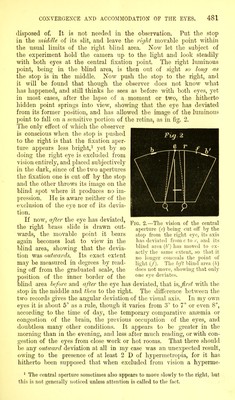
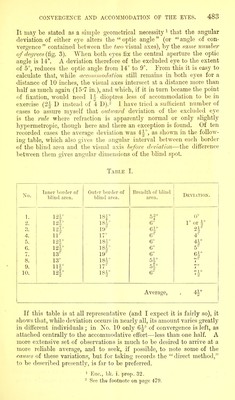
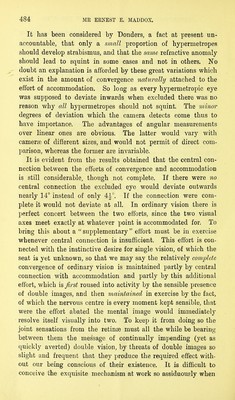
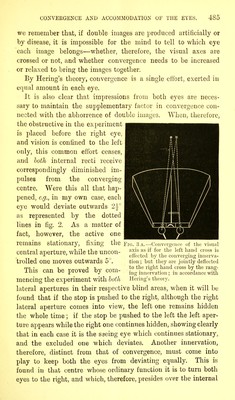
![It may be stated as a simple geometrical necessity 1 that the angular deviation of either eye alters the optic angle (or angle of con- vergence contained between the two visual axes), by the same number of degrees (fig. 3). When both eyes fix the central aperture the optic angle is 14°. A deviation therefore of the excluded eye to the extent of 5°, reduces the optic angle from 14° to 9°. From this it is easy to calculate that, while accommodation still remains in both eyes for a distance of 10 inches, the visual axes intersect at a distance more than half as much again (15-7 in.), and which, if it in turn became the point of fixation, would need 1J dioptres less of accommodation to be in exercise (2\ D instead of 4 D).'J 1 have tried a sufficient number of cases to assure myself that outward deviation of the excluded eye is the rule where refraction is apparently normal or only slightly hypermetropic, though here and there an exception is found. Of ten recorded cases the average deviation was 4J°, as shown in the follow- ing table, which also gives the angular interval between each border of the blind area and the visual axis before deviation—the difference between them gives angular dimensions of the blind spot. Table I. No. Tuner border of blind area. Outer border of blind area. Breadth of blind area. Deviation. 1. 2. q O. 4. 5. G. 7. 8. 9. 10. 12i ° 12§° 12|° 11 m° m° 13° 13° ii¥ 12J° m° 18}° 19° 17° m° 19° m° 17° 181° 6f 6° 6V Gu 6° 6° 6° 6J° 51° 6° 0° 1° or h° 2** 4° 4i° 5° 6F 7° 7° Average, 4J° If this table is at all representative (and I expect it is fairly so), it shows that, while deviation occurs in nearly all, its amount varies greatly in different individuals; in ]Sro. 10 only 6^° of convergence is left, as attached centrally to the accommodative effort—less than one half. A more extensive set of observations is much to be desired to arrive at a more reliable average, and to seek, if possible, to note some of the causes of these variations, but for taking records the direct method, to be described presently, is far to be preferred. 1 Euc, bk. i. prop. 32. 2 See the footnote on page 479.](https://iiif.wellcomecollection.org/image/b21636291_0011.jp2/full/800%2C/0/default.jpg)