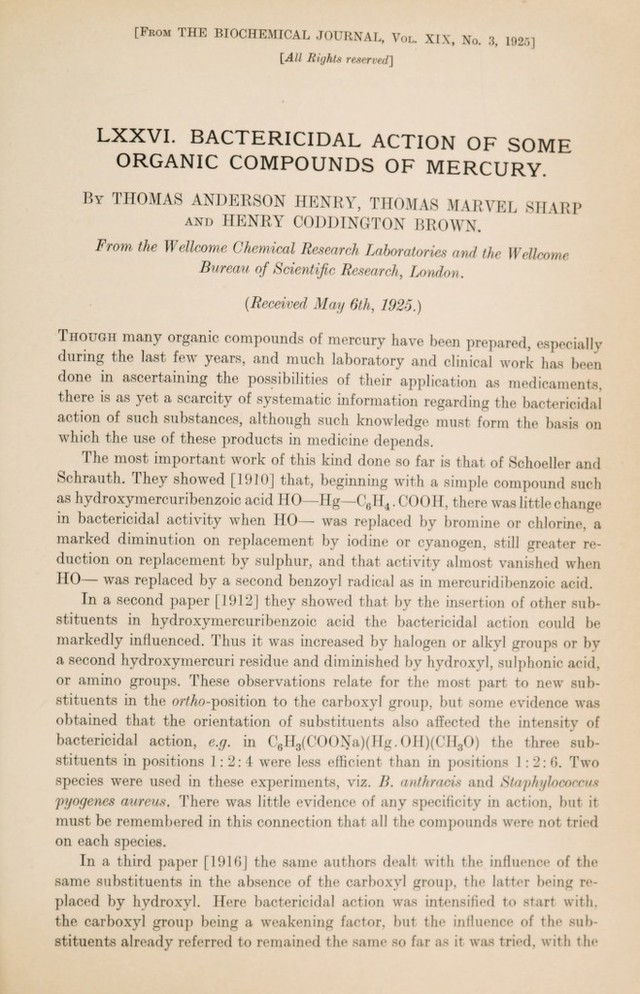
Bacterial action of some organic compounds of mercury / by T.A. Henry, T.M. Sharp, and H.C. Brown.
- Thomas Anderson Henry
- Date:
- [1925.]
Licence: Public Domain Mark
Credit: Bacterial action of some organic compounds of mercury / by T.A. Henry, T.M. Sharp, and H.C. Brown. Source: Wellcome Collection.
4/12 page 514
![addition of the nitro-group to the augmenting series. The three mercurated isomeric cresols arranged themselves in these trials in the following order of diminishing activity: meta, ortho, para. Reference may also be made to Miss de Witt’s work [1921] which relates mainly to the possibility of using organic compounds of mercury in tuberculosis, and covers a large number of substances ranging from mercuric chloride to complex products including chloromercuri derivatives of dyes such as methylene blue, trypan blue, methylene green, etc. The results are expressed in terms of mercury required to inhibit the growth of human tubercle bacilli on melted nutrient agar; and from the present point of view they are chiefly of interest in showing the variation in the amount of mercury (g. per litre) required for this purpose, depending on the organic or inorganic residue with which it is associated, the least effective being mercuric chloride (0-093) and the most active, acetoxymercuriallyl alcohol, HO. CH2CH : CH. HgO. Ac (0-012), chloro- mercurimethylene blue (0-014) and chloromercurifluorescein (0-016). There are numerous other papers on the subject but the foregoing account is sufficient to show the general position. It occurred to us that valuable information might be obtained by starting with a comparatively simple substance, mercurating it and a suitable selection of its derivatives and determining the bactericidal action of the resulting mercury compounds, keeping throughout to strictly comparable conditions, and using for comparison certain standard mercury compounds, which are already in more or less general use in medicine. Of the numerous possible starting points for such an investigation we selected benzaldehyde mainly because, when we began this work, no mer¬ curated derivatives of aromatic aldehydes had been made. The substances so far prepared have been described and their constitution discussed elsewhere [Henry and Sharp, 1922, 1924], and in the present paper only their bactericidal action need be discussed. For the elucidation of certain points it proved desirable to make a number of other organic mercury compounds, for example, those of the alkyl phenols, from which we hoped to obtain information as to the effect of replacing the aldehyde group by alkyl groups. Further, for certain clinical trials which became necessary in the course of this work, derivatives soluble in oils had to be made, and this was done by converting the hydroxymercuri compounds into salts of higher fatty acids, such as oleic, myristic, chaulmoogric, etc. These salts, which are described briefly later on, are readily soluble in almond, olive and other oils and such solutions are suitable for chemotherapeutic experiments on animals where aqueous solvents are inadvisable or useless. The bactericidal tests were all made by the methods described below, using Bacillus typhosus, Rawlings. B. typhosus was selected as the test organism in preference to B. coli for the reasons put forward by Anderson and McClintock [1912] viz., (1) the greater reliability of the strains in the former organism, (2) the proof that the growth in the medium is actually due to B. typhosus and not to accidental](https://iiif.wellcomecollection.org/image/b30625270_0004.jp2/full/800%2C/0/default.jpg)