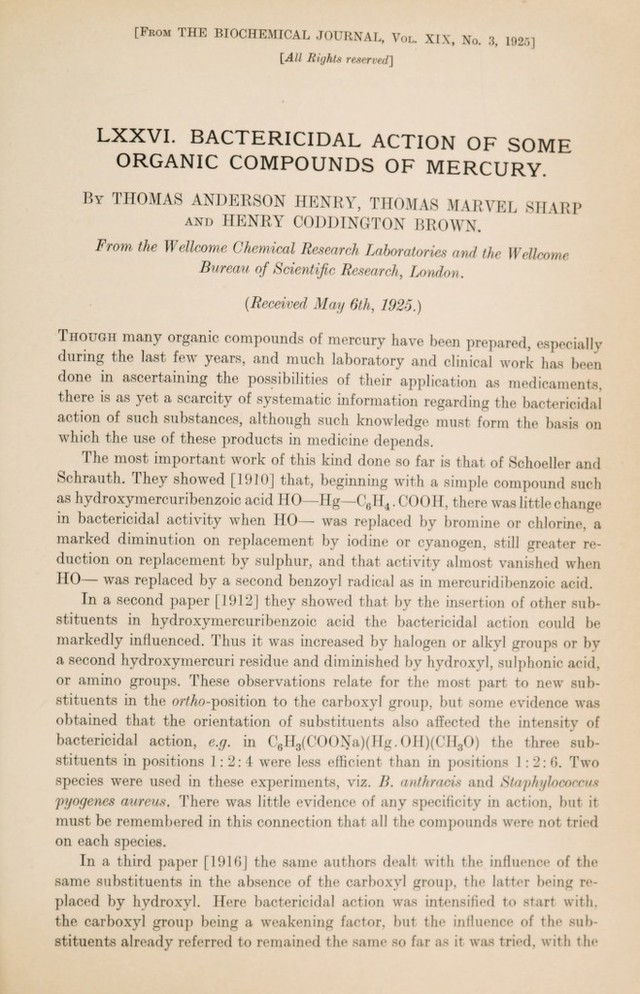
Bacterial action of some organic compounds of mercury / by T.A. Henry, T.M. Sharp, and H.C. Brown.
- Thomas Anderson Henry
- Date:
- [1925.]
Licence: Public Domain Mark
Credit: Bacterial action of some organic compounds of mercury / by T.A. Henry, T.M. Sharp, and H.C. Brown. Source: Wellcome Collection.
5/12 page 515
![contamination is easily made by using specific agglutination with a high titre serum. Aqueous solutions. Most of these mercury compounds are insoluble in water but form sparingly soluble sodium or potassium salts and these were used for the tests carried out in water. The solutions were diluted to a suitable series of known concentrations with sterile distilled water and quantities of 5 cc. mixed with 0*2 cc. of a 24 hours broth culture of B. typhosus, Rawlings, filtered through paper. This was allowed to interact for 5 minutes at 20° and a 3 mm. platinum loopful taken into 10 cc. of sterile broth and incubated at 37° for 48 hours. The tubes showing growth in the highest concentration were tested with typhoid serum and a control serum for specific agglutination. Serum solutions. It is now well known that the bactericidal action of many substances is reduced when they are used in presence of serum and to ascertain how this medium affected mercury compounds some trials were made with normal horse serum, which had been passed through a Berkefeld candle and heated at 58° for 2 hours. The serum in this case was used as a diluent in place of sterile distilled water as in the previous test. Oil solutions. For the reason already stated (p. 514) it was desirable to see how the use of oil as a solvent for oil-soluble mercury compounds affected their use as bactericidal agents and these tests were carried out as follows. The reagents were diluted in sterile olive oil. 5 cc. quantities were tubed and to these varying dilutions, 0*02 cc. of the filtered broth culture was added; the tubes were then closed with sterile rubber corks and the contents vigorously shaken. After 5 minutes’ interaction in a water-bath at 20 cultures were taken as before. Results of Experiments. The substances are indicated by typical formulae as far as possible, e.y. in Table I, substance No. 1 is 3 : 5-dihydroxydimercuri-2-hydroxybenzaldehyde, which is represented thus C6H2[(CHO)(Hg.OH)2(OH) =1 : 3 : 5 : 2]. From the results given (Table I) it is clear that the introduction of a mercury residue into the molecule of an organic compound enhances the bactericidal action of the latter: thus, whilst a 0*5 % solution of m-hydroxybenzaldekyde only kills B. typhosus after 4 hours' action, solutions of all the mercury de¬ rivatives of m-hydroxybenzaldehyde are much more active bactericidal agents, the most potent towards B. typhosus being hydroxymercuri-4-nitro-3-hydroxv- benzaldehyde (No. 7, Table 1) which kills in o minutes at a concentration of 0*004 %, whilst the least active are the dihydroxydimercurinitro-3-hvdroxy- benzaldehydes (Nos. 4 and 8, Table 1) which are toxic in 5 minutes at a con¬ centration of 0*06 %. It is noteworthy in this connection that so fai fiom enhancing the bactericidal action, as stated by Schoeller and Schrauth, the introduction of a second mercury residue appears to reduce it, all tin* dimeicuri derivatives of nitro-m-hydroxybenzaldehyde (Nos. 4, 0, 8, in I able I) being](https://iiif.wellcomecollection.org/image/b30625270_0005.jp2/full/800%2C/0/default.jpg)