British flowering plants / illustrated by three hundred full-page coloured plates reproduced from drawings by Mrs. Henry Perrin ; with detailed descriptive notes and an introduction by Professor Boulger.
- George Simonds Boulger
- Date:
- 1914
Licence: In copyright
Credit: British flowering plants / illustrated by three hundred full-page coloured plates reproduced from drawings by Mrs. Henry Perrin ; with detailed descriptive notes and an introduction by Professor Boulger. Source: Wellcome Collection.
69/344
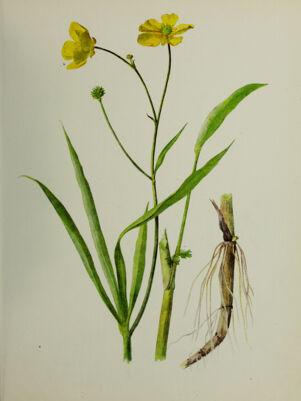
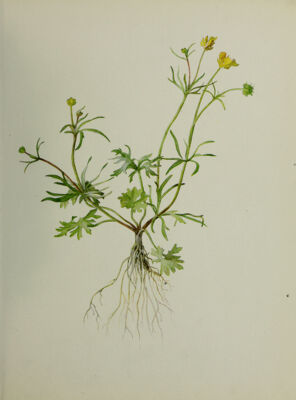
![THE GREATER SPEARWORT—continued. margins. Bentham in his “British Flora” (1865) refers only to aerial leaves, which he describes as “ glabrous with a few nearly parallel veins,” as also does Hooker in his “ Student’s Flora,” his full description being “ leaves sessile, ^-amplexicaul lanceolate entire or toothed . . . 6-10 in. f-i in. broad, veins parallel or reticulated.” Nevertheless the presence of submerged leaves seems to have been observed at least as early as Caspar Bauhin, who writes in his “ Pinax Theatri Botanici” ((623), “ Folia prima aliquando subrotunda sunt.” Parkinson also seems to have seen them, since in his “ Theatrum ” (i 640) he says :— “ The Greater Marsh Spearwort hath a long joynted root, whence riseth up a thick joynted smooth stalke, two foot high, furnished with large and long shining and smooth thinner leaves, than in the next [f?. Flammula L.], some being more than half a foote long and two to three inches broad, but smaller up to the toppe.” Two centuries later these submerged leaves were correctly described by Bromfield in his “Flora Vectensis ” (1856), by Syme in “English Botany” (1863), and most fully by Roper in the “Journal of the Linnean Society ” in 1884. They are seven to nine inches long, on sheathing petioles which are four or five inches long, the blades three or four inches across, ovate-oblong, obtuse, cordate at the base, entire or slightly undulate-crenate, rather membranous and semi-transparent, perfectly glabrous, reticulately veined, and remaining green throughout the winter. On the other hand, the aerial leaves are almost sessile, with sheathing bases, erect, lanceolate, six to ten inches long, about an inch across, very acute, with slight distant serratures, leathery, opaque, smooth or hairy with adpressed hairs chiefly on their under surfaces. Their venation adds to their many resemblances to the leaves of aquatic Monocotyledons, there being one principal midrib from which pairs of much finer secondary longitudinal veins arise at intervals converging at the apex of the leaf, while fine obliquely transverse tertiary veins complete the meshwork. The handsome flowers are about two inches across, and have a copious secretion of honey from the large gland at the base of each petal. The stigmas mature before the anthers, which bend and burst outwards in succession ; but, though pollination is mainly effected by flies, self-fertilisation may also occur. The carpels are compressed, with a flat margin and a minutely pitted surface. The English name Spearwort obviously refers to the upper leaves, as does also the specific name Lingua that Linnaeus borrowed from Pliny ; but when Pliny says “ there is herb called ‘ lingua ’ which grows in the neighbourhood of fountains,” it is more probable that he was referring to the Hart’s-tongue Fern than to this plant. In spite of its aquatic habitat the Spearwort has the marked acridity of the Family, while the allied R. Flammula derives from this property its name, which signifies “ a Kttle flame.”](https://iiif.wellcomecollection.org/image/b28047497_0095.jp2/full/800%2C/0/default.jpg)
 No text description is available for this image
 No text description is available for this image
 No text description is available for this image