Licence: Attribution 4.0 International (CC BY 4.0)
Credit: The tests for purity of quinine salts / by Frank Tutin. Source: Wellcome Collection.
Provider: This material has been provided by The Royal College of Surgeons of England. The original may be consulted at The Royal College of Surgeons of England.
12/14 page 10
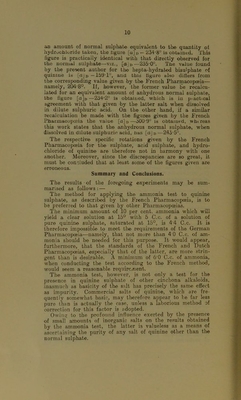
![an amount of normal sulphate equivalent to the quantity of hydrochloride taken, the figure [a]D— 234-8° is obtained. This figure is practically identical with that directly observed for the normal sulphate—viz., [oJd—235-0°. The value found by the present author for the hepta-hydrated bisulphate of quinine is [«Jd —159-1°, and this figure also dillers from the corresponding value given by the French Pharmacopoeia— namely, 204-8°. If, however, the former value be recalcu- lated for an equivalent amount of anhydrous normal sulphate, the figure [ajo—234-2° is obtained, which is in piactical agreement with that given by the latter salt when dissolved in dilute sulphuric acid. On the other hand, if a similar recalculation be made with the figures given by the French Pharmacopoeia the value [o]D—300-9° is obtained, whtreas this work states that the anhydrous normal sulphate, when dissolved in dilute sulphuric acid, bas [aJD—243-5°. The respective specific rotations given by the French Pharmacopoeia for the sulphate, acid sulphate, and hydro- chloride of quinine are therefore not in harmony with one another. Moreover, since the discrepancies are so great, it must be concluded that at least some of the figures given are erroneous. Summary and Conclusions. The results of the foregoing experiments may be sum- marised as follows: — The method for applying the ammonia test to quinine sulphate, as described by the French Pharmacopoeia, is to be preferred to that given by other Pharmacopoeias. The minimum amount of 10 per cent, ammonia which will yield a clear solution at 15° with 5 C.c. of a solution of pure quinine sulphate, saturated at 15°, is 44 C.c. It is therefore impossible to meet the requirements of the German Pharmacopoeia—namely, that not more than 4 0 C.c. of am- monia should be needed for this purpose. It would appear, furthermore, that the standards of the French and Dutch Pharmacopoeias, especially that of the latter, are more strin- gent than is desirable. A minimum of 6'0 C.c. of ammonia, when conducting the test according to the French method, would seem a reasonable requirement. The ammonia test, however, is not only a test for the presence in quinine sulphate of other cinchona alkaloids, inasmuch as basicity of the salt has precisely the same effect as impurity. Commercial salts of quinine, which are fre- quently somewhat basic, may therefore appear to be far less pure than is actually the case, unless a laborious method of correction for this factor is adopted. Owing to the profound influence exerted by the presence of small amounts of inorganic salts on the results obtained by the ammonia test, the latter is valueless as a means of ascertaining the purity of any salt of quinine other than the normal sulphate.](https://iiif.wellcomecollection.org/image/b22425408_0014.jp2/full/800%2C/0/default.jpg)