An Introduction to the study of the protozoa with special reference to the parasitic forms / by E.A. Minchin.
- Minchin, Edward Alfred.
- Date:
- 1912
Licence: In copyright
Credit: An Introduction to the study of the protozoa with special reference to the parasitic forms / by E.A. Minchin. Source: Wellcome Collection.
Provider: This material has been provided by Royal College of Physicians, London. The original may be consulted at Royal College of Physicians, London.
64/550 page 48
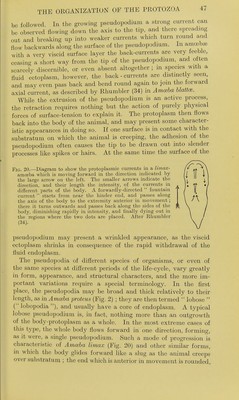
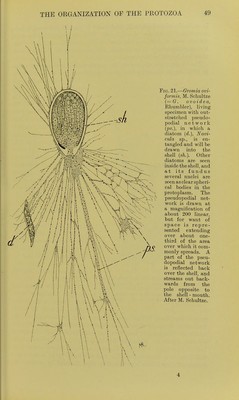
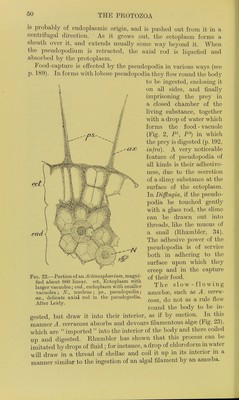
![sl!fulrt^ri^^ end commonly becomes drawn out into processes In othe. f . 'T 'V P^^^^^«P°dium in process of retraction. out on al .7' ''. r/- ^''^'T P^^^dopodia are sent out on all sides and balance each other, in which case there is very httle translation of the body as a whole, and the pseudopodia serve chiefly for food-capture. If, however, the outflow of the pseudo- podia is strongest on one side of the body, the organism moves in that direction as a whole, and the larger, more strongly developed pseudopodia counteract and overcome the pull exerted by those that are weaker. It wiU be readily understood, therefore, that the most rapid powers of progression are possessed by the slucr-like amoebae, m which a single pseudopodium drags the whole body along without opposition from others. Rhumbler (34) has drawn attention to the existence of two modes of progression exerted by amoebije of the lobose type. In the more fluid species which creep upon a substratum to which they adhere more or less firmly, like Amceba proteus, the animal pro- gresses by a flowing movement, such as has been described ; this is the commonest type of amoeboid locomotion. On the other hand, in species of the type of A. verrucosa and A. terricola the very slightly fluid body is limited by a thin pellicle, and does not adhere to the substratum; then progression is effected by rolling movement. The animal throws out a number of pseudopodia on one side, which cause it ultimately to overbalance and roll over to that side ; by continued repetition of this procedure, a slow progres- sion in a particular direction is efiected. At other times, however, A. verrucosa may flow along like other amcebae. Contrasting with the lobose pseudopodia are the slender, thread- like, so-called filose pseudopodia, formed entirely of ectoplasm. Pseudopodia of this type can effect a slow creeping movement, but are not very effective for locomotion, and serve for food-capture principally, or even entirely, as in the radiate floatmg forms (Heliozoa and Radiolaria) ; food is entangled by them and drawn into the body. The filose pseudopodia may radiate from the body in all directions, remaining separate from one another, or they may anastomose to form networks, and are then termed reticulose. Pseudopodia of the reticulose type are specially characteristic of the Foraminifera (Fig. 21). Radiate pseudopodia which do not form anastomoses, on the other hand, characterize the grou]DS of the Heliozoa and Radiolaria, organisms of floating habit. As noted above, pseudopodia of the radiate type are generally supported by an axial rod, a secreted structm'e of firm, elastic nature, and are hence known as axopodia. The actual rod reaches some way into the endoplasm, often to the centre of the](https://iiif.wellcomecollection.org/image/b22651822_0064.jp2/full/800%2C/0/default.jpg)