An Introduction to the study of the protozoa with special reference to the parasitic forms / by E.A. Minchin.
- Minchin, Edward Alfred.
- Date:
- 1912
Licence: In copyright
Credit: An Introduction to the study of the protozoa with special reference to the parasitic forms / by E.A. Minchin. Source: Wellcome Collection.
Provider: This material has been provided by Royal College of Physicians, London. The original may be consulted at Royal College of Physicians, London.
70/550 page 54
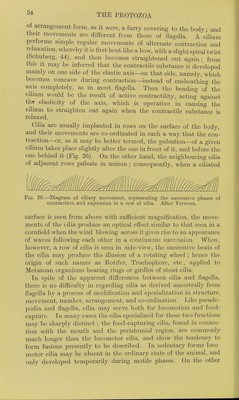
![ot arrangement form, as it were, a furry covering to the body • and their movements are different from those of flagcUa. A'c'ihum performs simple regular movements of alternate contraction and relaxation, whereby it is first bent like a bow, wth a slight spiral twist (Schuberg, 44), and then becomes straightened out again ; from this it may be inferred that the contractile substance is developed mainly on one side of the elastic axis—on that side, namely, which becomes concave during contraction—instead of ensheathing the axis completely, as in most flagella. Then the bending of the cilium would be the result of active contractility, acting against the elasticity of the axis, which is operative in causing the cilium to straighten out again when the contractile substance is relaxed. Cilia are usually implanted in rows on the surface of the body, and their movements are co-ordinated in such a way that the con- traction—or, as it may be better termed, the pulsation—of a given cilium takes place slightly after the one in front of it, and before the (me behind it (Fig. 26). On the other hand, the neighbouring cilia of adjacent rows pulsate in unison ; consequently, when a ciliated Fig. 26.—Diagram of ciliary movement, representing tlie successive phases of contraction and expansion in a row of cilia. After Verwom. surface is seen from above with sufficient magnification, the move- ments of the cilia produce an optical effect similar to that seen in a cornfield when the wind blowing across it gives rise to an appearance of waves following each other in a continuous succession. When, however, a row of cilia is seen in side-view, the successive beats of the cilia may produce the illusion of a rotating wheel ; hence the origin of such names as Rotifer, Trochophore, etc., applied to Metazoan organisms bearing rings or girdles of stout cilia. In spite of the appai'ent differences between cilia and flagella, there is no difficult}'^ in regarding cilia as derived ancestrally from flagella by a process of modification and specialization in structure, movement, number, arrangement, and co-ordination. Like pseudo- podia and flagella, cilia may serve both for locomotion and food- capture. In many cases the cilia specialized for these two functions may be sharply distinct; the food-capturing cilia, found in connec- tion with the mouth and the peristomial region, are commonly much longer than the locomotor cilia, and show the tendency to form fusions ]Dresently to be described. In sedentary forms loco motor cilia may be absent in the ordinary state of the animal, and only developed temporarily during motile phases. On the other](https://iiif.wellcomecollection.org/image/b22651822_0070.jp2/full/800%2C/0/default.jpg)