A popular treatise on venereal diseases, in all their forms : embracing their history and probable origin, their consequences, both to individuals and to society, and the best modes of treating them : adapted for general and private use / by Frederick Hollick.
- Frederick Hollick
- Date:
- [1852]
Licence: Public Domain Mark
Credit: A popular treatise on venereal diseases, in all their forms : embracing their history and probable origin, their consequences, both to individuals and to society, and the best modes of treating them : adapted for general and private use / by Frederick Hollick. Source: Wellcome Collection.
Provider: This material has been provided by the National Library of Medicine (U.S.), through the Medical Heritage Library. The original may be consulted at the National Library of Medicine (U.S.)
26/414
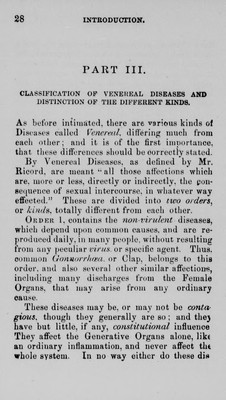
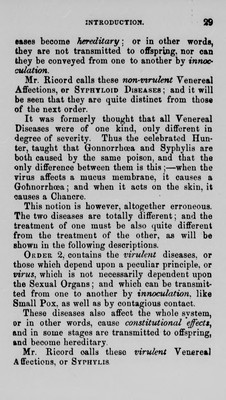
![back, n/l Venereal Diseases were thought to be similar in their nature, and this mistake origi- aated the confusion of ideas in regard to them which has heen noted. The fact is. as will be shown further on, there are twc distinct kinds of Venereal Diseases, the one called virulent, and the other non- virulent] and these differ from each other in many essential particulars. Both kinds can be transmitted from one person to another, either by sexual connexion or otherwise; but in their effects on the organization, and, as far as we can judge, in their origin, they in no way resemble each ether. The non-virulent Venereal Diseases, such as Gonnorrhrea for instance, will undoubtedly arise spontaneously, from various causes, besides being propagated from one person to another. Their effects are mainly confined to particular parts, and are such as often result from ordinary forms of inflammation. These complaints have probably existed, more or less, among all people. The virulent Venereal Diseases, such as Syphylitic Chancre,, or Bul/o. are altogether dif- ferent from those above mentioned, in almost every particular. As far as we know, Syphvlis is always contracted from some other person suffering from it, and never arises spontaneously. It appears, in fact, to be caused by a special virus, or matter, like that of the Small Pox, which communicates the disease to any part with which it comes in contact. Indeed, many per- sons have been innoculated with it. in the same way a^ for Small Pox. and the disease has fol- lowed from the innoculation.](https://iiif.wellcomecollection.org/image/b21129083_0026.jp2/full/800%2C/0/default.jpg)
 No text description is available for this image
 No text description is available for this image
 No text description is available for this image