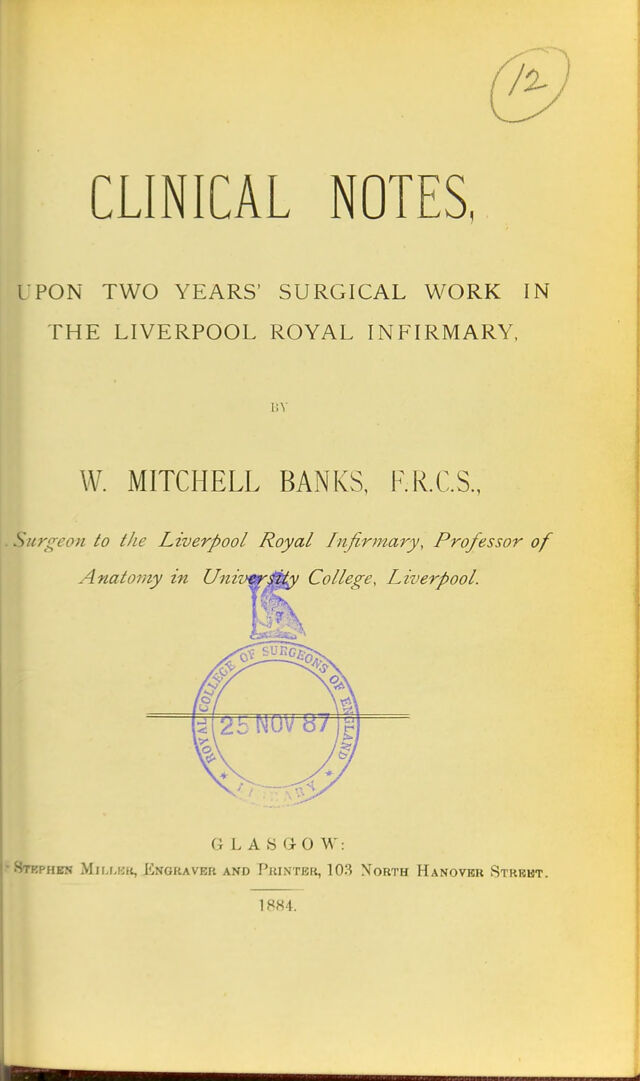
Clinical notes upon two years' surgical work in the Liverpool Royal Infirmary / by W. Mitchell Banks.
- William Mitchell Banks
- Date:
- 1884
Licence: Public Domain Mark
Credit: Clinical notes upon two years' surgical work in the Liverpool Royal Infirmary / by W. Mitchell Banks. Source: Wellcome Collection.
Provider: This material has been provided by The Royal College of Surgeons of England. The original may be consulted at The Royal College of Surgeons of England.
34/207 page 30
![practically Jiciiled and tlie arm was rendered aljsolutely iiniiiuv- able l)y a lioop iron splint let into a plaster casing, wliich envelojjed the upper ])art of the chest, the shoulder and the arm down to the wrist. Not the faintest movement could occur. For many months tlie arm was kept tlioroughly steady, but in spite of this no prcjper union occurred. Phospliorus internally was tried on the strength of its being said to ]n-oduce bony growth in dog.s. ]^ext we tied a handkercliief tiglitly round tlie arm abo\ e tlie fracture, so as U) keep a large supply of Itlood in and around the callus;—to congest it in fact. Finally three steel drills were dri\-en through the callus and left for about three weeks initil they dropped out of their own accord—still no union. So, seventeen months after the first oper- ation, the old incision was re-o])ened and the old condition dis- covered again, namel)', a most ])erfect iilu'ous union. The fibrous mass even contained a cavity which lield a little Unit I. The bones were sawed ol)li(iuely and an ivory peg was driven through both of them at one part and a strong silver wire at another—holes having Ijeen bored witli a dentist's drilling engine. On this occasion anti- septics were not employed. During the subsequent thirty-.six houi-s tliere was so mucli oozing tliat the wound had to be opened and stulTed witli lint soaked in turpentine. After that all sorts of abscesses and suppurations formed, resulting in the speedy carrying away both of ivory peg and silver wire. The arm was .simply hung in a .sling and poulticed and for a month the patient was very ill indeed. By degrees the wound granulated \\\) and an inside rect- angular splint was got on. At the end of about four months tliere was complete union with an enormous mass of callus. It was a great question with us wliether tlie primary union obtained at the first operation, combined with the absolute immolnUty of the frag- ments, so far from Ijeiug serviceable were not positively conducive to non-union. In fact there was not .sufficient irritation to induce the formation of ossific material around the recently sawed ends oi the bone. That there is some truth in this idea is shewn by tlie fact that after the second operation (which Wiis conducted witliout antiseptics) there was such an amount of infianunation and su])\m- ration tliat the arm could not be kept in any splints at all, and the fragments were absolutely unsu]iported and moved about an}-how. ITevertheless, an abundant callus formed and excellent union re- sulted. If a fracture seems xery slow to unite, the orthodox treat-](https://iiif.wellcomecollection.org/image/b22294806_0034.jp2/full/800%2C/0/default.jpg)