Volume 1
The universal dictionary of trade and commerce : with large additions and improvements, adapting the same to the present state of British affairs in America, since the last treaty of peace made in the year 1763. With great variety of new remarks and illustrations incorporated throughout the whole: together with everything essential that is contained in Savary's dictionary: also, all the material laws of trade and navigation relating to these kingdoms, and the customs and usages to which all traders are subject / By Malachy Postlethwayt, esq.
- Jacques Savary des Brûlons
- Date:
- 1766
Licence: Public Domain Mark
Credit: The universal dictionary of trade and commerce : with large additions and improvements, adapting the same to the present state of British affairs in America, since the last treaty of peace made in the year 1763. With great variety of new remarks and illustrations incorporated throughout the whole: together with everything essential that is contained in Savary's dictionary: also, all the material laws of trade and navigation relating to these kingdoms, and the customs and usages to which all traders are subject / By Malachy Postlethwayt, esq. Source: Wellcome Collection.
123/1108
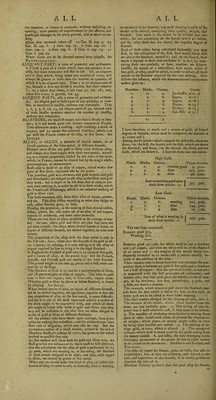
![fctvw paper that fias been dipped into allum, from fin kino-, when written on. 3 There are three principal forts of allum ; namely, the allum of Rome, or Civita Vecchia ; the allum of England, other- wife called rock allum, white allum, or ice allum; and the allum of Liege, or Meziers; befides that which comes from the Levant. The Allum of Rome, fays F. Labat, is reddifh, becaufe the earth whence it is taken is of that colour. In order to have the heft, you muft chufe that which has but little duft, is red¬ difh both within and without; and, above all, take care it be not counterfeit; for there are people, who know how to give a reddifli colour to the allum of England and ,Liege. The fureft fign by which you may know it to be counterfeit, is, when, by breaking it, it is not fo red within as without. The Allum of England, is in great pieces, or lumps, clear and tranfparent like cryftal. It is more or lefs fine accord¬ ing as it has been well or ill purified. Sometimes there is allum found of a blackifli colour, and fomething moift. In order to chufe it good, it muft be white, clear, tranfparent, dry, with but little duft, or dirt. F. Labat obferves, that there is another kind of allum made in England, which is alfo called roch, or ice allurn; it is the fame as that we fpeak of in this article; but adds, that it is not by far fo good as that of Civita Vecchia. Monf. Lemery afcribes the fame qualities to it as to the former, out obferves, that it is not of fo great ufe in phyfic, becaufe it is not fo ftrono'/ The Englifh rock, or roche «illum, is made from a bluifh mi¬ neral ftone, which abounds in the hills of Yorklhire and Lan- cafhire. They calcine it on a hearth or kiln, and then fteep it fucceffively in feveral pits of water. Afterwards they boil it for about twenty-four hours, and then let it ftand for about two hours, the impurities fubfiding, and leaving a clear li¬ quor, which is put into a cooler, adding a due proportion of urine to it. In three or four days it begins to gather into a lump, which being taken out, wafhed, and purified over again is fit for ufe. 5 ’ The Manner of difcovering and preparing Allum at Civita Vecchia. The ftone that produces allum is taken out of the open fields, and not out of quarries, as free-ftone is in France, and other countries. T*he workmen, who are ufed to fearch and rake for thofe ftones, know by certain tokens, and by a long experience, which are the places where they are to be found without much raking or digging. In thofe places, whtch abound moft with allum, there commonly grow fmall ftrubs, called agrifolios, in the language of that country. They are ever-greens, and much like the holms that are feein in Provence and elfewhere: but the agrifolios have their bark green as well as the leaves, which/are broad, thorny, and of a darker green than the bark. In meeting with thofe Ihrubs, either upon the mountains of Tolfa, or on the fides of them, or in the plane, it is a fure fign that there is allum- ltone underneath; and the more there are of thofe Ihrubs, the more certain we may be of meeting therewith. There are fometimes met with allum-ftones fpread upon the furface of the earth. 1 hat fign cannot be equivocal; it fhewin°- that you may dig without fear of being difappointed, and be «rtain that the bed or vein lies near, and is plentiful. I hey employ commonly three forts of workmen, for the finding and raking of thofe ftones. The firft may be filled the difcoverers. They are thofe, who, by a long experience, are become expert in the knowledge of the figns, which point out the places where the allum-ftones lie. Thefe direcft the work, in order to trace the vein, and not to be milled, when any obftacle is in the way that may occafion a miftake. The fecond are thofe who break the rocks, which fometimes inclofe the good ftones, and cover or hide the veins. Befides pick-axes, iron wedges, and twi-bills, which they ufe, they are alfo often obliged to blaft them with gunpowder, as in metallic mines. 7 he third workmen are thofe who pick and chufe the ftones; for thofe that are found in the fame vein are not all true allum-ftones. ’Tis neceffary to have a perfect knowledge of them, not to be miftaken, othenvife the farmers of them would be drawn into ufelefs, and often very confiderab16, expences. The ftones are commonly whitilh, greytfh, or blue, or even mixed with thofe three Thofe marks however, are lefs fure than the grain, which fe.dom milleads thofe who are ufed to that fearclf, and to the picking of the ftones. When all thofe figns prove equivocal, they burn and calcine two or three wheel-barrows full of the Hones; and, by the r,T;;s.juJgc of what b= «*•*■* ^ «■* When the Hones prove good, they carry them to the kiln, Zt l Tm“y 'T* the f,l]es of « wh=n they de- fign to make lime ; and they give them more or lefs lire, ac¬ cording to the qualtty of the fl„„e, and the „ature } £ place whence it was taken. That is to fay, if the Hone fa hit and dry, and was taken from an open place on the mp o. the mountain, where it wa, cxpofed to the heat of the fun, it requires much lefs fire, than when it is Toft but moili icing taken out or the bowels of the earth, where it had A L M nothing but moiflure, and very little of the fun’s beat. It i, impoffible to prefcribe general rules upon this futJjecL be- muft he 1T?JS uery mUCh fr°m the circumfonces, which whoh^. 1 a- tle caPac,ty and honefty of the workmen, who have the diredion of the work; but yet the mafter ough^ For 2S mUC1’ °r ™ore tflan t{leya to prevent impofition. w c t XPenCeft°fkth,S manufadture is very large; befides rhi ^ KUft bn 3°’°00 CrOWns Paid to the apoftolic the neSh , Wh°m ^ Sround of ^ofe allum mines and tne neighbouring woods belono-. When the ftones are baked,^and the kiln uncovered they ficienTb^?011683 feC°,nd timC’ 2nd thofe which are fuf- fiuently baked, are carried to the place where they are to be ex mguifhed : they put into a feparate place of the kiln thofe ftones that are not enough, in order to bake them a fecond time with other frefh ftones that are to be put in! fernnd h K A' bif-cakes> ^caufe of their fecond baking. They throw away as ufe efs thofe that were bumf, inftead of being only baked; and thefe they call fcales. * 1 he hones that are fufficiently baked, are carried into a place Grounded, with low walls, the foil or ground of which is wed paved, and has little channels dug into it to o-ather t e water. 7 hey make a heap of thole ftones between two channels, and make the heap commonly 15 or 18 feet lon°- and 5 or 6 broad at bottom; and 8 feet high, and narrow at the top; and they take care that the fides be very fmooth and very clofe. Upon that heap of ftones, they throw water with fcopes m order to extinguifh the fire hid within the ftones, as is pradftifed in the burning of lime-ftones. This work is continued night and day, during 25 or 30 days, and til the water, thrown upon the heaps, runs off perfedly c^dL For till that time the ftones heat the water, that runs oft after having penetrated them; and is fo hot in the be¬ ginning, that it perfectly boils. The heat decreafes by de¬ grees, as the ftones which have been fet on fire, begin to cool. That water is carefully kept, not only to extinguifh other ftones, but alfo to put it into coppers with the ftones that have been baked and extinguifhed: for that water could not pafs through the pores of the ftone, with¬ out being impregnated with a great quantity of alluminous particles: fo that it helps to form the grains of allum in the moulds : they call that water lye. When the ftones are entirely extinguifhed, and reduced to a foft, and as it were, a liquid mafs, they carry the whole into large coppers, . wherein they pour a fufficient quantity of the water, which ferved to .extinguifh them; and they kin¬ dle a very great fire under it, that is continued for 16, 18 or even 20 hours: during this time they ftir the boiling matter with non {hovels, to make the ufelefs ftones, earth° and other drofs, come to the top, which they fkim off, to purify the whole. They continue this work, till the matter, or, as they ftile it, the alluminous lye, be clear, clean, and thoroughly liquid. When in that condition, they pour it into wooden <mt- ters, which convey it into fquare wooden frames, made^af- ter the manner of inverted pyramids, about 4 or 5 feet high, and 2 feet and a half broad. The point of the pyramid is bored through, but they flop the hole, when they pour the lye into it. They leave it there to fettle and cool, for 10 or 12 days j- duiing which time the alluminous particles unite too-ether, and flick to the fides of the frame, where they harden, and form an infinite number of various figures. When they judge that the whole quantity of allum they can expert, is formed, they open the hole at the bottom of the frame, to let out what remains of the lye, that is not con¬ gealed ; but, before they take the allum out, they pour more lye into the frame, to wafh it and purify it from the drofs and filth that may flick to it’s outfide : and, after having left the refldue a day or two to dry, they take it out of the forms, and lay it up in the warehoufes. There are about 60 days required to perform that work, from the time the ftone was taken out of the quarry or vein, till the allum be fit For fale. The farmers of this manufacture make confiderable profits by it, notwithftanding the high price they pay for their farms, and the expences they are at. They have warehoufes at Ci¬ vita Vecchia, where it is weighed, and from thence it is car¬ ried in bags into the veflels of the purchafers, which are ge¬ nerally barques from Marfeilles. ALLURE, or ALLEVEURE, a fmall brafs coin ftruck in Swe¬ den, worth about 4 French fols, or about 2; Englifh money. Two allures make a roufting, and 8 rouftings a mark of cop¬ per. ALMADY, a fmall canoe, four fathoms long, generally made of the bark of trees ; it is ufed by the negroes on the coaft of Africa, to trade among themfelves, and with the Europeans, who lie off the fhore for trade. Almady, is alfo a veffel ufed in the Eaft-Indies; it is made in the form, of a weaver s fhuttle, except that it is fquare at the ftern. Some of them are 80 feet long, and 6 or 7 feet wide. They carry great ftore of merchandize, and with thefe veflels the richeft Indian mercnants drive their greateft trade; whether](https://iiif.wellcomecollection.org/image/b30459436_0001_0123.jp2/full/800%2C/0/default.jpg)