Volume 1
The universal dictionary of trade and commerce : with large additions and improvements, adapting the same to the present state of British affairs in America, since the last treaty of peace made in the year 1763. With great variety of new remarks and illustrations incorporated throughout the whole: together with everything essential that is contained in Savary's dictionary: also, all the material laws of trade and navigation relating to these kingdoms, and the customs and usages to which all traders are subject / By Malachy Postlethwayt, esq.
- Jacques Savary des Brûlons
- Date:
- 1766
Licence: Public Domain Mark
Credit: The universal dictionary of trade and commerce : with large additions and improvements, adapting the same to the present state of British affairs in America, since the last treaty of peace made in the year 1763. With great variety of new remarks and illustrations incorporated throughout the whole: together with everything essential that is contained in Savary's dictionary: also, all the material laws of trade and navigation relating to these kingdoms, and the customs and usages to which all traders are subject / By Malachy Postlethwayt, esq. Source: Wellcome Collection.
265/1108
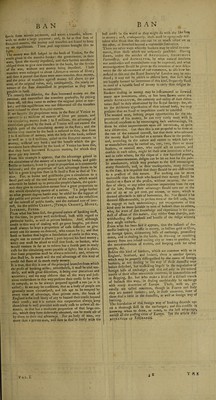
![i. ■ t nrf, but thev may haVe it imported thitlier ftorn England ? Wder to bT goo'd, it ought to be frefh of an ao-reeable and penetrating feent, pretty much like the ba.m of Judaea. Ask grows old, it becomes of the conhftency of ThedSlm]lftiled liquid amber, is a clear and reddifli rofin, i ■ u comes from certain trees in New Spam, which ar 33^ b.y the native\ The bark of thofe trees rsvery Tht’balm isTalledTiquiiVmbe6!' alfo^becaufe it very much Smbl s ambergreafeq, and the beft ought to have the fame S bdm Is an excellent remedy for the cure of wounds, and. efoecially of & fiftuls. in flno« They fometimes fell oil of St John’s wort, or of chamomde, iufteud of oil of liquid umber. We menuon the 0,1 of chu- ±1 under the utricle of Ore. As for that o Sr Johns ,..nrr vrhich may be ftiled a true balm, after it has been made for fon-e Le, it is competed of the flowers of St Tohn’s wort, and olive-oil cxpofcd to the lun during the great K of Ac dog-days. The beft is that, to whrcK fine tur- K“^fohtefokarce In France,’ that hardly any thine of it is known there but it’s name, and which is not to be met with, but in the (hops of fome curious druggifts, conSs pretty near the balm of Tolu, both in imell and co¬ lour' it is Squeezed after the fame manner as oil of laurel, and is extradited from fmall red berries, which are {of'T}' mon enough in the ifle of St Domingo. They grow in clus¬ ters or bunches upon trees, the leaves of which are very broad and long, extremely green on the outfide; but only little greenilhm the infide! They tell wonders of that balm, but it’s reputation is, perhaps, owing to it’s fcarcity only There is a mineral balm found in a mine m Italy, upon which FCaftaena a iefuit, publifhed his obfervations and experi- mentsl the’PhilofophLl Tranfadions, for the year 1697, No 79. art. 3. The reader may alfo fee in the fame Tranf- fai’oll for the year 1666, No, 8. art. 4, anobfervatmn upon the mineral balm,-found in Alface. . p ,• Monfieur Geoffroy, of the Royal Academy of Sciences at Par s having fet fire to fome natural balms, fuch as thofe or Capau and Mecca, obferved, that, being burned, they fpread into the air a perfume, which, being weakened to a certain de¬ gree, becomes veny fweet, extends very far, and continue^ a Iretty long while. It is chiefly the balm of Capau, that has that agreelble property. See the Memoirs of that academy White balm is reckoned one of thofe merchandizes that come from the Levant, from Barbary, and other countries and territories under the dominion of the Grand Seignior, the kino- of Perfia, and Italy; upon which it is ordered in France to raife a duty’ of twenty per cent, of their value, according to a decree of the council of the 15th of Auguft 16S5. BAMBOE, or BAMBOU, as they fpell that word in the Indies, and not bamboue. It is a plant which multiplies very much by it’s root, from which fpririgs a ramous or branchy tuft, after the manner of fome gramma, or, to {peak more naturally, after the manner of the European reeds; for .he bamboe is of the kind of reeds, as well as the fugar-cane. i he Indian bamboe is the largeft kind of cane that is known. I is of an extraordinary beighth and bignefs, when it bears it bloflom: each {hoot or cane k often, towards the bottom, of the bignefs of a man’s thigh, and decreales gradually to the top, where it bears a bloffom cr flower, .like oui reeds, in their proper feafon. The bamboe grows in all the mari¬ time countries of the Eaft-Indies. Monfieur Lemery calls 1 a tree, whofe leaves refemble thofe of the olive-tree. But John Bauhin, from whom he has extradled his defcription, has milled him: for it is not a tree, though it grows very high, even to 20 of 25 feet, and fometimes to 30.' It s leaves are like thofe of other canes or reeds, except that they are not lo long nor fo broad at their bafe, as thofe of the other kinds : they are but half a foot long, and their breadth, towards the middle, is an inch, or fomething more. With thefe canes of bamboe the Indians build their houfes, and make all lorts of furniture, in a very ingenious manner. The wood ot thefe canes is fo hard and ftrong, that they ferve very well to make piles for fupporting their little houfes, built over n- vers, which have a gentle courle, as it it were over flaming waters. They alfo make with this wood all forts of uten fils for their kitchens and tables. The thickeft bamboes ferve to make the flicks or poles, with which the flaves or ot ei nerfons carry thofe forts of litters, which are called palan¬ quins, and are of fo common an ufe, and fo convenient in al the eaft. They likewife make of that wood a kind of pails, in which the water keeps extremely cool. The walking-canes which we fee in Europe, are the firft and fmalleft ih°ots ° the bamboes. The Malays and thofe Chinefe, who are (1 Vql. L B A N perfed in the MoluccoCs and Sunda ifles, ufe the young fuiali {hoots of the bamboes preferved in vinegar alter their man ¬ ner, with very ftrong or peppered ingredients. This they call achior-bamboe. For they give the name of achior to al). that is preferved in vihegar* and, to diftinguifh it, they add to that name of achior that ot the thing preferved. See Achia. Two pieces of bamboe of a certain bignefs, be¬ ing rubbed hard againft each other after a certain manner.; will produce fire ; and, when the Indians cannot get any by other means, they obtain it that way. B A M F F S HIR E, in Scotland, is feparated on the fouth from that part of Buchan, which belongs to Aberdeenfhire, by the water of Ugie ; on the eaft it has the water of Dovern, and the German ocean; on the weft the water of Spey, and the county of Murray ; on the fouth-weft it has Badenoch, and the Brae of Mar; and on the north, Murray Frith* The climate and foil are much the fame, as in Aberdeenfhire. The chief places here, are, Cullen, a good market-town and ancient royal burgh, on the coaft of the Frith of Murray, and the capital of that little diftridt called Boyne, which is fruitful on the coaft, but elfewhere mountainous, with.large quarries of {potted marble. Bamff, on the fame coaft, at the mouth of the Dovern, is a county-town* and royal burgh, but has little trade, ex¬ cept from it’s corn and faimon-frfhing, the townfmen being fonder of tillage than pf commerce. ■ Frazerburg, a. fea-port on th.c coau. of Murray I1 nth,' reckoned the chief town of the diftri£1 of Buchan. It has an excellent pier and bulwark, which renders it as fafe and commodious as any on the eaft coaft; fo that 30 !ail of ftiap- ing may fecurely winter here at a time.1 The water* attuli fea, is 18 or 20 feet. . • / f , BalVENY, is a mountainous diftridt, on the weft-.iueof the {hire, upon the river Spey, abounding with pafture and wood, and particularly noted for a rock that is pro.dudtive of hones, and whetfton.es enough to ferve the whole lfland ; fo that the people here cover their houfes with them inftead of flate. Here are alfo found veins of that ftone, of which they make allum, and here are fprings of allum-water. . Strathyla, to the north-eaft of Balveny, is fruitful in corn and grafs, and has fuch plenty oHime-ftone, that they build their houfes with it. The inhabitants are coniiderable gainers by felling their lime for cattle and fine linnen-yarn, at a weekly market* in the village of Keith, on the river Dovern. . . a 6. StrathaVIN, is on the river Avin, falls into tne opey, which is more inclined to pafture than coin. ^ _ BAN a fort of fmooth and fine muflin, which the rtnghih im¬ port from the Eaft-Indies. The piece is almoft a yard broad, and runs about 20 yards and a half. Ban or Bann, is, according to Mr. Savary, an old Saxon word, which fignifies to banifh, proferibe, or outlaw a per- fon to interdidl him of water and fire, a punifhment formerly in ufe among the Romans; to condemn a man for contumacy, that is, for default or want of appearance, if his perfon can¬ not be come at. In this fenfe they fay,, to put a man or a prince to the ban of the empire; that is to fay, to bani-h him, or cut him off from being a member of the empire. At Paris a rogue whofe crime is not capital, is condemned to go out of the city, county, and provoftfhip, for a certain number of years, and he is commanded to keep his ban, or banifhment, under fuch and fuch penalties. Others are of opinion, that ban is a Britifn word, which fignifies noife and clamour. Others derive it from the Saxon pan, which fignifies any thing that is fpread ; and hence the words ban and band are taken foi a flag. Ban, in general, is Paid of a public cry or proclamation. Hence the nodee given publickly of the fale of fome merchandizes, is called ban in French, efpecially when the notice is given bV beat of drum. They alfo ufe the fame word for the pub¬ lic cry of loft goods, with a reward offered for the recovery of them. We have kept the word ban, or banns, in our lan¬ guage, tofignify a proclamation made at the head of a body or troop, by the found of trumpet, or beat of drum, for the obferving of martial difeipline; as alfo to give a folemn n0~ ti.ee of marriage contrafts, made in the parffh churches of B A N C b?fn Midword which fignifies bank. It is com- monly ufed .to fignify the bank ot Venice. BAND, a fmall weight of about two ounces, ufed in om parts of the coaft of Guinea, to weigh gold-duit. B AN I AN S, the Dutch write BEN J A N S, a kind 0 mdi- ans difperfed over all Al,., through whole hands paCes almoft the whole trade which the Europeans carry on in thofe parts. They are the third fed! of the heathens who dvvcll in the Faft-Indies. The Banians and the Chinete are the grea.d traders in the Indies, to whom muft alfo be added the Jews and the Armenians, who are greatly difperfed over thofe Barts But the moft confiderable trade is carried on by the Banians, in the whole peninfula on this fide the Ganges/ They are extremely fkilful and cunning in commerce. W hat Furetiere tells us of the Banians, relates to almoft all the feds of the Indians, or heathens tn thofe parts. He lias ex- Aed it from an inaccurate hift.ory, written by Henry Lloyd 2 D trad](https://iiif.wellcomecollection.org/image/b30459436_0001_0265.jp2/full/800%2C/0/default.jpg)