Volume 1
The universal dictionary of trade and commerce : with large additions and improvements, adapting the same to the present state of British affairs in America, since the last treaty of peace made in the year 1763. With great variety of new remarks and illustrations incorporated throughout the whole: together with everything essential that is contained in Savary's dictionary: also, all the material laws of trade and navigation relating to these kingdoms, and the customs and usages to which all traders are subject / By Malachy Postlethwayt, esq.
- Jacques Savary des Brûlons
- Date:
- 1766
Licence: Public Domain Mark
Credit: The universal dictionary of trade and commerce : with large additions and improvements, adapting the same to the present state of British affairs in America, since the last treaty of peace made in the year 1763. With great variety of new remarks and illustrations incorporated throughout the whole: together with everything essential that is contained in Savary's dictionary: also, all the material laws of trade and navigation relating to these kingdoms, and the customs and usages to which all traders are subject / By Malachy Postlethwayt, esq. Source: Wellcome Collection.
91/1108
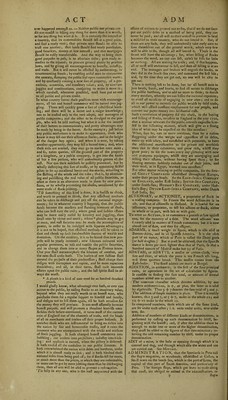
![A.C G rJ ' .. , # • ‘ , t ' : • Notwithftanding what has been faid, ’tis very defirable that our Britifh manufactures may go as cheap to foreign mar¬ kets, as thofe of our rival nations, which are not fuperior in point of quality. Upon this principle Mr. Locke reafoned ; and ’tis upon this principle that merchants of the moft money and (kill purchafe commodities at firfl: hand of the manu¬ facturer, pay him ready cafti, and fend their goods abroad, with every advantage. And thefe exportures of cur manufactures, who are not in circumftances to fend them abroad at firfl: hand, are an inju¬ ry, rather than a benefit to the national trade; they irijudici- oufly glutting the markets abroad, which finks the price too often below what they can afford to fell at; and yet they are importunate for remittances, and thereby force their faCfors to fell almoft at any rate. Such merchants not only hurt the trade of a kingdom, but are fure to hurt themfelves, and all who have connexions in trade with them. A real Mercantile Example. Account of Sales, and net proceeds of 2 bales of druegets, received per the Hollandia, Capt. Jan, RoelofFSmith, for the account of M. P. of London. Nov. 4. 1740. Configned the above 2 bales of druggets qt. 112 pieces qt. 4875 yards as per fa&ory [i. e. invoice, which is frequently fliled fo] which a 3 J palms per yard are palms 18280 net, a fols 9 s. 4d. per palm, to pay in two months — 1 — — •— 8530 134 Sold and configned 2 pieces of white druggets for wrappers as above, for — — 140 00 o 8670 13 4 C H A R G E S, viz. Freight and primage —• — 106 5 o Porters landing and carrying to wareh. 600 Opening to vifit, afforting and making up — — — — 400. Warehoufe room — ~ 800 Brokerage 2 r per cent. -- 43 7 o To commifiion and /landing to bad debts a 4 per cent. —— 346 16 4 - 514 3 4 8156 5 o Aggio deduCled a 118 § per cent. 1283 o 2 Genoa, 30th Nov. 1740. E. E. * Bco. 6873 4 10 * E. E. Signifies Errors excepted in the account rendered, and Bco. fignifies the Bank money of Genoa. Remarks. 1. Foreign accounts of fales of merchandizes, are or ought to be, governed in fome meafure by the invoice, fent there¬ with from the principal. See Invoice. 2. Merchants, being inured to hazard from their firfl; fetting out in life, fend their property to foreign countries with as much alacrity, on the good faith and honour of their cor- refpondents, as a monied man lends his property at home on land fecurity. Credit therefore, is the great foundation of commerce be¬ tween nation and nation, as well as between one man and another in the fame nation. Whence it follows, that the firfl: principle the trader fliould tenacioufly cultivate, is the fupport of his perfonal credit. 3. It too often falls out, that thofe who take up their refi- dence at foreign faftories, no fooner get a houfe eftablifhed there, than they ufe every art to draw people in, to fend them large confignments of merchandizes by commifiion. To which end, they at firfl: make remittances to their principals in a reafonable time, and give them an handfome profit upon their goods, in order to induce them to increafe their confign¬ ments. 4. When they have thus drawn people in to entruft a large fortune in their hands abroad, it is then that they too often begin to ufe every dilhonourable art, to keep them out of their money. L you prefs for remittances, you are given to underftand, tnat notiiing can procure them but frefh confignments, which have proved the ruin of many ; and, it you draw upon them for your property, your credit may fuffer by that means at home. 5. On thefe confiderations, our moft opulent and experienced merchants have eftablilhed houfes of their own at many of the Briufli factories in foreign countries; wherein they breed up a luccefiion of perfons, whom they gradually take into partnerfhip, which makes it for their intereft to be punctual and faithful. 6. Such capital houfes feldom take commifiion from any, but the perfons who are the principals belonging to thofe houfes : and luch are generally capable to fupply them, with whatever 8 ACC are able to vend, and thole too with that variety o afiortments, which engage the natives to give the prefe- re.ice to thefe houfes, in their general dealings. 7- t er houfes, which take comrryflions in the general, and nevei give any in return, too often ufe no little craft in the ma ing out their foreign accountrof (ales, by couching great impositions under many of their articles of charges, which they have never paid. 8. Nor is this the only practice which ought to be guarded agamic Goods perhaps may be fold at three or four months credit, or for ready money, and yet the principal kept out of his property for years, by falfe and frivolous pretences. Thefe arts are mentioned, with a view only to guard the young and unexperienced from being too cafily enfnared 5 and we hope they will have the good efifea thereby intended ■ ACCOUNTANT, or ACCOMPTANT, one who is not only well (killed in calling up all forts of accounts, and rea¬ dily performs all arithmetical operations, but who is verfed in the art of book-keeping, by charge and difeharge, or bv debtor and creditor. ^ ' I his appellation is applicable to a perfon, or officer, appoint¬ ed to keep the accounts of a public company, or office; as the accountant of the South-Sea, or India companv, or of the Bank, the Cuflom-houfe, or Excife, fee. ACCOUN FANTSHIP, comprehends not only a fkill in fi¬ gures or arithmetic, but a knowledge in the art of account- keeping by debtor and creditor, or by the* method of regular charge and difeharge, according to the nature of the tranf- adlions; which method keeps every diflindt account, if they are ever fo numerous, always fit for a ballance : and that bal- lance is found by fubtra&ing the fum total on the debit fide fiom the fum total on the credit fide, or the fum total of the latter from that of the former. T o be (undamentally grounded in arithmetical operations requires a competent acquaintance with geometry and alge¬ bra, becaufe the geometric and algebraic way of reafonmg difeovers certain rules and theorems, whereby to calculate numerically in the moft concife'manner: and to be properly grounded in the nature of debtor and creditor requires a know¬ ledge in the art of keeping accounts, according to the method of double entry, or what is commonly diftinguifhed by the Ita¬ lian method of Book-keeping, or by the name of Merchant’s Accounts. Frcm^hence it may be obferved, that no perfon can be pro¬ perly find to be duly (killed in accountantftiip, without beino- fkrlled in the^art of debtor and creditor, as well as in that of numbers. nor, on the other hand, ooes any one deferve the name of an accountant, who is only acquainted with book¬ keeping, and not with figures. The art of accountantftiip is not only applicable to the re¬ gular adjuftment of the variety of tranfadtions among traders of every denomination, but alfo to the private affairs of gen¬ tlemen and noblemen. And as it well becomes all perfons of the greateft diftindtion to take due care of their eftates ; fo nothing, perhaps, can have a happier tendency to that end, than a knowledge in the art of debtor and creditor, as well as that of numbers. For * merchants accounts, fays- Mr. ‘ Locke, though a feienee not likely to help a gentleman to * get an eftate, yet poflibly there is not any thing of more £ ufer and efficacy to make him preferve the eftate he has. ‘ ’Tis feldom obferved, that he who keeps an account of his ‘ income and expence, and thereby has coijftantiy under view * the courfe of his domeftic affairs, lets then* run to ruin. * And I doubt not but many a man gets behind-hand before ‘ he is aware, or runs farther on, when he is once in, for c want of this care, or the fkill to do it. I would therefore c advife all gentlemen to learn perfedfly merchants accounts, * and not to think it a fkill that belongs not to them, becaufe ‘ it has received its name, and has been chiefly pratftifed by ‘ men of traffic.’ Nor is accountantftiip lefs ufeful to the gentlemen of the Jaw, than to private gentlemen ; and not only to thofe who are intended for the bar, but to all follicitors and attornies ; litigations between traders making fo confiderable a propor¬ tion of the bufinefs of our courts of law and equity.* With¬ out the perfedt knowledge of debtor and creditor in particu¬ lar, accounts may be fo craftily and fophiflically ftated, as to deceive the moft upright judge and jury, as well as the coun¬ cil, if they are not capable of unravelling them in the courfe of their pleadings. Perfons of diftintftion alfo, who are concerned in the chief ports of the public revenue, or who act in the fenatorial ca¬ pacity, cannot be too well /killed in accountantftiip. The one will thereby be enabled to acquit himfelf with credit and reputation, in whatever branch of the revenue he (hall be employed ; and the other will become perfectly acquainted with the finances and money affairs of the kingdom. For fuch is the nature and excellency of the mercantile art of debtor and creditor by double entry, that it is as eafily appli¬ cable to the accounts of nations as to thofe of traders, 6r private gentlemen, millions bein* as familiarly aJjufted there¬ by, as hundreds of pounds. When once a perfon is ac¬ quainted with the feveral funds from whence the national re¬ venue arifes, as liketyife their appropriations to the payment of \ /](https://iiif.wellcomecollection.org/image/b30459436_0001_0091.jp2/full/800%2C/0/default.jpg)