Politzer's text-book of the diseases of the ear and adjacent organs : for students and practitioners / translated at the request of Professor Politzer and edited by James Patterson Cassells.
- Ádám Politzer
- Date:
- 1883
Licence: Public Domain Mark
Credit: Politzer's text-book of the diseases of the ear and adjacent organs : for students and practitioners / translated at the request of Professor Politzer and edited by James Patterson Cassells. Source: Wellcome Collection.
Provider: This material has been provided by University of Bristol Library. The original may be consulted at University of Bristol Library.
41/858 (page 21)
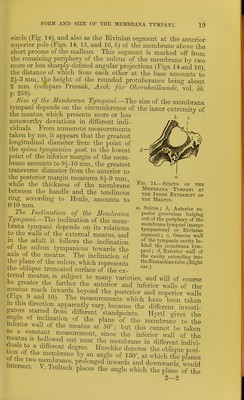
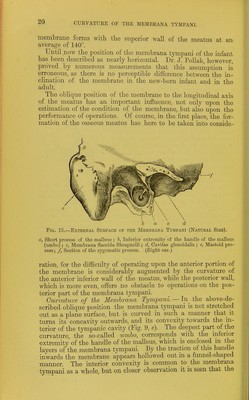
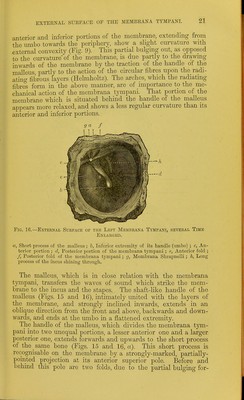
![anterior and inferior portions of the membrane, extending from the umbo towards the periphery, show a sHght curvature with external convexity (Fig. 9). This partial bulging out, as opposed to the curvature'of the membrane, is due partly to the drawmg inwards of the membrane by the traction of the handle of the malleus, partly to the action of the circular fibres upon the radi- ating fibrous layers (Helmholtz). The arches, which the radiating fibres form in the above manner, are of importance to the me- chanical action of the membrana tympani. That portion of the membrane which is situated behind the handle of the malleus appears more relaxed, and shows a less regular curvature than its anterior and inferior portions. f7 a / ill S Fig. 16.—External Surface op the Left Membrana Tympani, several Time Enlarged. «, Short process of the malleus ; b, Inferior extremity of its handle (umbo) ; c, An- terior portion ; d, Posterior portion of the membrana tympani ; e. Anterior fold ; J] Posterior fold of the membrana tympani; g, Membrana Shrapnelli; h, Long process of the incus shining through. The malleus, which is in close relation with the membrana tympani, transfers the waves of sound which strike the mem- brane to the incus and the stapes. The shaft-like handle of the malleus (Figs. 15 and 16), intimately united with the layers of the_ membrane, and strongly inclined inwards, extends in an oblique du-ection from the front and above, backwards and down- wards, and ends at the umbo in a flattened extremity. The handle of the malleus, which divides the membrana tym- pani into two unequal portions, a lesser anterior one and a larger posterior one, extends forwards and upwards to the short process of the same bone (Figs. 15 and 16, a). This short process is recognisable on the membrane by a strongly-marked, partially- oiiited projection at its anterior superior pole. Before and ehind this pole are two folds, due to the partial bulging for-](https://iiif.wellcomecollection.org/image/b21446362_0041.jp2/full/800%2C/0/default.jpg)