Licence: Public Domain Mark
Credit: Notes on nursing : what it is, and what it is not. Source: Wellcome Collection.
Provider: This material is part of the Elmer Belt Florence Nightingale collection. The original may be consulted at University of California Libraries.
57/92 page 51
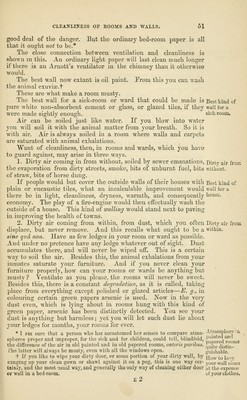
![good deal of the danger. But the ordinary bed-room paper is all that it ought not to be.* The close connection between ventilation and cleanliness is shown m this. An ordinary light paper will last clean much longer if there is an Arnott's ventilator in the chimney than it otherwise would. The best wall now extant is oil paint. From this you can wash the animal exuviae.t These are what make a room musty. The best wall for a sick-room or ward that could be made is Best kind of pure white non-absorbent cement or glass, or glazed tiles, if they wall for a were made sightly enough. ' sickroom. Air can be soiled just like water. If you blow into water you will soil it with the animal matter from your breath. So it is with air. Air is always soiled in a room where walls and carpets are saturated with animal exhalations. Want of cleanliness, then, in rooms and wards, which you have to guard against, may arise in three ways. 1. Dirty air coming in from without, soiled by sewer emanations, Dirty air from t]ie evaporation from dirty streets, smoke, bits of unburnt fuel, bits v/ithout. of straw, bits of horse dung. If people would but cover the outside walls of their houses with Be?t kind of plain or encaustic tiles, what an incalculable improvement would wall for u there be in light, cleanliness, dryness, warmth, and consequently liouse. economy. The play of a fire-engine would then efiectually wash the outside of a house. This kind of walling would stand next to paving in improving the health of towns. 2. Dirty air coming from within, from dust, which you often Dirty air from displace, but never remove. And this recalls what ought to be a within. sine qua non. Have as few ledges in your room or ward as possible. And under no pretence have any ledge whatever out of sight. Dust accumulates there, and will never be wiped oiF. This is a certain way to soil the air. Besides this, the animal exhalations from your inmates saturate your furniture. And if you never clean your furniture properly, how can your rooms or wards be anything but musty ? Ventilate as you please, the rooms Avill never be sweet. Besides this, there is a constant degradation, as it is called, taking place from everything except polished or glazed articles—E. g., in colouring certain green papers arsenic is used. Now in the very dust even, which is lying about in rooms hung with this kind of green paper, arsenic has been distinctly detected. You see your dust is anything but harmless; yet you will let such dust lie about your ledges for months, your rooms for ever. * I am sure that a person who has accustomed her senses to compare atmo- -vtmospnerp-a spheres proper and improper, for the sick and for children, could tell, blindfold, \'ii^(j rooms the difference of the air in old painted and in old papered rooms, cceter Is paribus, q^jte distin- fhft latter will always be musty, even with all the Avindows open. jTuishable. ^ + If you like to wipe your dirty door, or some portion of your dirty wall, by |jq^^ ^^ j.^..^ Hanging up your clean gown or shawl against it on a peg, this is one way cer- your wall clean tairdy, and the most usual way, and generally the only way of cleaning either door at the expence or wall in a bed-room. of your clothes, e2](https://iiif.wellcomecollection.org/image/b20452524_0057.jp2/full/800%2C/0/default.jpg)