Britain, or a chorographicall description of the most flourishing kingdomes, England, Scotland, and Ireland, and the Ilands adioyning, out of the depth of antiqvitie : beavtified with mappes of the severall Shires of England / written first in Latine by William Camden ; Translated newly into English by Philémon Holland.
- William Camden
- Date:
- 1610
Licence: Public Domain Mark
Credit: Britain, or a chorographicall description of the most flourishing kingdomes, England, Scotland, and Ireland, and the Ilands adioyning, out of the depth of antiqvitie : beavtified with mappes of the severall Shires of England / written first in Latine by William Camden ; Translated newly into English by Philémon Holland. Source: Wellcome Collection.
36/1348 page 8
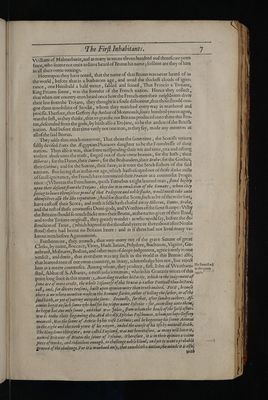
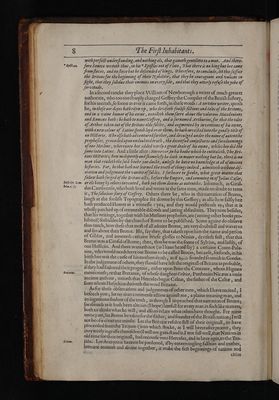
![—M ee (e (eaves Sn AR SANE IS i is rS — B4 k 3 Lhe Firft Inhabitants. * Epi 44. Defcript. Cati. bria.c. 7: Bretautus, Livins, fore Seneca writeth thus ,in bis * Epiftles out of Plato, That there is no king but hee came Sromflaves, and no flave but he defcended of kings. Wherefore, to conclude, let this fuffice the Britans for the beginning of their Nobilitie, that they be courageous and valiant in fight, that they fubdue their enemies on every fide, and that they utterly refufe the yoke of Jervitude. In afecond rancke they place William of Newborough a writer of much greater authoritie, who too too fharply charged Geffrey the Compiler of the Britifh hiftory, for his untruth, fo foone as ever it came forth, in thefe words : 4 certeine writer, quoth he, iz tbefe our dayes hath rifen vp , who devifeth foolifh fictions and tales of the Britans, andin a vaine humor of bis owne , extolleth themfarre aboue the valorous Macedonians and Romans both : he hath to name Geffrey, and ts furnamed Arthurius, for that the tales of Arthur taken out of the Britans olde fables, and augmented by inventions of his owne, with anew colour of Latine (peech layd over them, he hathinvested into the goodly title of an Historie, Whe alfohath adventured farther, and divulged under the name of autentike prophefies, grounded upon undoubted truth , the deceitful conjectures and foredeemings of one Merline , whereunto hee added verily a great deale of his owne , whiles bee did the fame into Latine, And alittle after: Moreover jin his booke which he entituleth, The Bri- tans Histories bow malapertly and fhamele/ly he doth in maner nothing but lie, there is no man that readeth the [aid booke can doubt, unleffe he have no knowledge at all of ancient hiftories. For, hethat hath not learned the truth of things indeed , admitteth without dif- cretion and judgement the vanitie of fables, 1 forbeare to []eake, what great matter that fellow bath forged of the Britans atts, before the Empire, and comming in of Julius Cafar, or els being by ethers invented , hath put them downe as autentike. Infomuch, as Giral- dus Cambrenfis, who both lived and wrote at the fame time, tnade no doubt to term it, The fabulous [Tory of Geffrey. Others there be , who in this narration of Brutus, laugh at the foolifh Topographie fet downe by this Geffrey; as alfo. bow falfly hee hath produced Homer as a witneffe : yea, and they would perfwade us; that it is wholly patched up of untuneable difcords and jarring abfurdities. They note befides, that his writings, together with his Metlines prophefies,are (among other books pro- hibited) forbidden by the church of Rome to be publifhed. Some againe do obferve thus much, how thefe that moft of all admire Brutus, are very doubtfull and waverto and fro about their Brutus. He, fay they, that taketh upon him the name and perfon of Gildas, and annexeth certaine briefe gloffes to Ninius , devifeth firft ; that this Brutus was a Conful ofRome ; then, that he was the fonne of Sylvius, and laftly, of one Hefficio. Andthere wanteth not (asIhaue heard fay) a. certaine Count-Pala- tine, who would needs have our Brutus to be called Brotus, becaufe, forfooth, in his birth hee was the caufe of his mothers death , asif 25; founded fo much in Greeke, Inthe judgement of others; they fhould have left the originall of Britans as probable, ifthey had fathered their progenie , either upon Brito the Centaure, whom Higinus mentioneth; orthat Bretanus, of whofe daughter Celtice, PartheniusNiczus a verie ancient authour , writeth that Hercules begat Celtus, thefatherof the Celtz , and from whom Hefychius deriveth the word Britaine. Asfor thefe obfervations and judgements of other men , whichIhave recited , I befeech you, let no man commenfea&ion againft me, a plaine meaning man, and an ingenuousftudent of the truth , as though I impeached that narration of Brutus; forafmuch as it hath been alwaies (1 hope) lawfull for every man in füch like matters, both to thinke what he. will, and alfoto relate whatothershave thought. For mine ewne part, lec Brutus be taken for the father; and founder of the Britifh nation ; Iwill notbeofa contrarie minde? Let the Britains refolve ftill-of their originall, to have ptocecded from the Trojans (into. which ftocke, as I will heereafter proove , they may truely ingrafte themfélves)L will not gain-ftand it] wot full well,that Nations in old time for their originall, had recourfe vnto Hercules, and in later ages,to the Tro- Jans. LetAntiquitie heerein be pardoned; ifby entermingling falfities and truthes, hiimane inátter$ and divine together, it make the firft beginnings of nations and Bi cities](https://iiif.wellcomecollection.org/image/b30334974_0036.jp2/full/800%2C/0/default.jpg)
 No text description is available for this image
 No text description is available for this image
 No text description is available for this image