A manual of physiology : for the use of junior students of medicine / by Gerald F. Yeo.
- Date:
- 1884
Licence: Public Domain Mark
Credit: A manual of physiology : for the use of junior students of medicine / by Gerald F. Yeo. Source: Wellcome Collection.
Provider: This material has been provided by the Royal College of Physicians of Edinburgh. The original may be consulted at the Royal College of Physicians of Edinburgh.
35/676 page 11
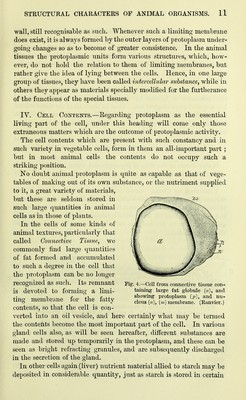
![wall, still recognisable as siicli. Whenever such a limiting membrane does exist, it is always formed by the outer layers of protoplasm under- going changes so as to become of greater consistence. In the animal tissues the protoplasmic units form various structures, which, how- ever, do not hold the relation to them of limiting membranes, but rather give the idea of lying between the cells. Hence, in one large grouj) of tissues, they have been called intercellular substance, while in others they ajDpear as materials specially modified for the furtherance of the functions of the special tissues. lY. Cell Contents.—Regarding protoplasm as the essential living part of the cell, under this heading will come only those extraneous matters which are the outcome of protoplasmic activity. The cell contents which are present with such constancy and in such variety in vegetable cells, form in them an all-important part ; but in most animal cells the contents do not occupy such a striking position. No doubt animal protoplasm is quite as capable as that of vege- tables of making out of its own substance, or the nutriment supplied to it, a great variety of materials, but these are seldom stored in such large quantities in animal cells as in those of plants. In the cells of some kinds of animal textures, particularly that called Connective Tissue, we commonly find large quantities of fat formed and accumulated to such a degree in the cell that the protoplasm can be no longer recognized as such. Its remnant is devoted to forming a limi- ting membrane for the fatty contents, so that the cell is con- verted into an oil vesicle, and here certainly what may be termed the contents become the most important part of the cell. In various gland cells also, as will be seen hereafter, different substances are made and stored up temporarily in the protoplasm, and these can be seen as bright refracting granules, and are subsequently discharged in the secretion of the gland. In other cells again (liver) nutrient material allied to starch may be deposited in considerable quantity, just as starch is stored in certain Fig, 4.—Cell from connective tissue con- taining- large fat globule (a), and showing protoplasm (^), and nu- cleus [n], {m) membrane. (Ranvier.)](https://iiif.wellcomecollection.org/image/b21932943_0035.jp2/full/800%2C/0/default.jpg)
 No text description is available for this image
 No text description is available for this image
 No text description is available for this image