A manual of physiology : for the use of junior students of medicine / by Gerald F. Yeo.
- Date:
- 1884
Licence: Public Domain Mark
Credit: A manual of physiology : for the use of junior students of medicine / by Gerald F. Yeo. Source: Wellcome Collection.
Provider: This material has been provided by the Royal College of Physicians of Edinburgh. The original may be consulted at the Royal College of Physicians of Edinburgh.
60/676 page 36
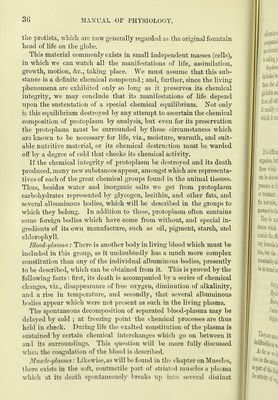
![tlie protista, which are now generally regarded as the original fountain head of life on the glohe. This material commonly exists in small independent masses (cells), in which we can watch all the manifestations of life, assimilation, growth, motion, &c., taking place. We must assume that this sub- stance is a definite chemical compound; and, further, since the living phenomena are exhibited only so long as it preserves its chemical integrity, we may conclude that its manifestations of life depend upon the sustentation of a special chemical equilibrium. Not only i.s this equilibrium destroyed by any attempt to ascertain the chemical composition of protoplasm by analysis, but even for its preservation the protoplasm must be surrounded by those circumstances which are known to be necessary for life, viz., moisture, warmth, and suit- able nutritive material, or its chemical destruction must be warded off by a degree of cold that checks its chemical activity. If the chemical integrity of protoplasm be destroyed and its death produced, many new substances appear, amongst which are representa- tives of each of the great chemical groups found in the animal tissues. Thus, besides water and inorganic salts we get from protoplasm carbohydrates represented by glycogen, lecithin, and other fats, and several albuminous bodies, which will be described in the groups to which they belong. In addition to these, protoplasm often contains some foreign bodies which have come from without, and special in- gredients of its own manufacture, such as oil, pigment, starch, and chlorophyll. Blood-plasma: There is another body in living blood which must be included in this group, as it undoubtedly has a much more complex constitution than any of the individual albuminous bodies, presently to be described, which can be obtained from it. This is proved by the following facts: first, its death is accompanied by a series of chemical changes, viz., disappearance of free oxygen, diminution of alkalinity, and a rise in temjierature, and secondly, that several albuminous bodies appear wliich were not present as such in the living plasma. The spontaneous decomposition of separated l)lood-2)lasma may be delayed by cold ; at freezing point the chemical processes are thus held in check. During life the exalted constitution of the plasma is sustained by certain chemical interchanges which go on between it and its surroundings. This question will be more fully discussed wlien the coagulation of the blood is described. ALnsde-plasma: Likewise,as will be found in the chapter on Muscles, there exists in the soft, c(mtractile part of striated muscles a ])l;iMna which at its death spontaneously breaks up into several distinct](https://iiif.wellcomecollection.org/image/b21932943_0060.jp2/full/800%2C/0/default.jpg)