A manual of physiology : for the use of junior students of medicine / by Gerald F. Yeo.
- Date:
- 1884
Licence: Public Domain Mark
Credit: A manual of physiology : for the use of junior students of medicine / by Gerald F. Yeo. Source: Wellcome Collection.
Provider: This material has been provided by the Royal College of Physicians of Edinburgh. The original may be consulted at the Royal College of Physicians of Edinburgh.
636/676 page 612
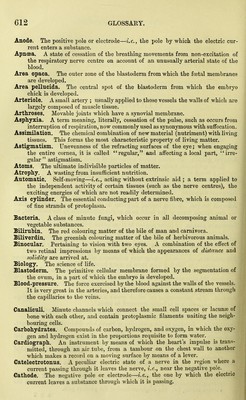
![Anode. The positive pole or electrode—i. c., the pole by which the electric cur- rent enters a substance. Apnoea. A state of cessation of the breathing movements from non-excitation of the respiratory nerve centre on account of an unusually arterial state of the blood. Area opaca. The outer zone of the blastoderm from which the foetal membranes are developed. Area pellucida. The central spot of the blastoderm from which the embryo chick is developed. Arteriole. A small arteiy ; usually applied to those vessels the walls of which are largely composed of muscle tissue. Arthroses. Movable joints which have a synovial membrane. Asphyxia. A term meaning, literally, cessation of the pulse, such as occurs from interruption of respiration, now commonly used as synonymous with suffocation. Assimilation. The chemical combination of new material (nutriment) with living tissues. This forms the most characteristic property of living matter. Astigmatism. Unevenness of the refracting surfaces of the eye; when engaging the entire cornea, it is called regular, and affecting a local part, irre- gular astigmatism. Atoms. The ultimate indivisible particles of matter. Atrophy. A wasting from insufficient nutrition. Automatic. Self-moving—i.e., acting without extrinsic aid ; a term applied to the independent activity of certain tissues (such as the nerve centres), the exciting energies of which are not readily determined. Axis cylinder. The essential conducting part of a nerve fibre, which is composed of fine strands of protoplasm. Bacteria. A class of minute fungi, which occur in all decomposing animal or vegetable substances. Bilirubin. The red colouring matter of the bile of man and camivora. Biliverdin. The greenish colouring matter of the bile of herbivorous animals. Binocular. Pertaining to vision with two eyes. A combination of the effect of two retinal impressions by means of which the appearances of distance and solidity are arrived at. Biology. The science of life. Blastoderm. The primitive cellular membrane formed by the segmentation of the ovum, in a part of which the embryo is developed. Blood-pressure. The force exercised by the blood against the walls of the vessels. It is very great in the arteries, and therefore causes a constant stream through the capillaries to the veins. Canaliculi. ]\linute channels which connect the small cell spaces or lacunse of bone with each othej-, and contain protoplasmic filaments utiiting the neigh- bouring cells. Carbohydrates. Compounds of carbon, hydrogen, and oxygen, in which the oxy- gen and hydi-ogen exist in the proportions requisite to form water. Cardiograph. An instrument by means of which the heart s impulse is trans- mitted, through an air tube, from a tambour on the chest wall to another which makes a record on a moving siirface by means of a lever. Catelectrotonus. A peculiar electric state of a nerve in the region Avhere a current passing tln-ough it leaves the nei-^-e, i.e., near the negative pole. Cathode. The negative pole or electrode—i.e., the one by which the electric current leaves a substance through which it is passing.](https://iiif.wellcomecollection.org/image/b21932943_0636.jp2/full/800%2C/0/default.jpg)