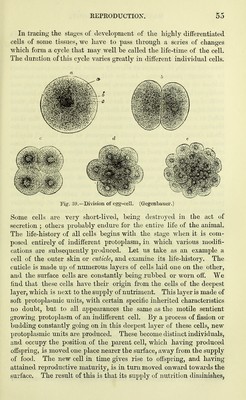
A manual of physiology : for the use of junior students of medicine / by Gerald F. Yeo.
- Date:
- 1884
Licence: Public Domain Mark
Credit: A manual of physiology : for the use of junior students of medicine / by Gerald F. Yeo. Source: Wellcome Collection.
Provider: This material has been provided by the Royal College of Physicians of Edinburgh. The original may be consulted at the Royal College of Physicians of Edinburgh.
83/676 page 59
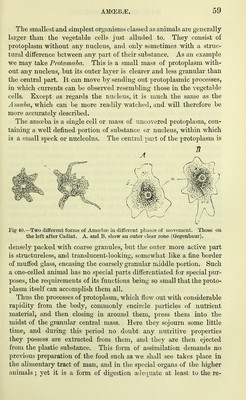
![The smallest and simplest organisms classed as animals are generally larger than the vegetable cells just alluded to. They consist of jDrotoplasm without any nucleus, and only sometimes with a struc- tural difference between any part of their substance. As an example we may take Protamoeha. This is a small mass of protoplasm with- out any nucleus, but its outer layer is clearer and less granular than the central part. It can move by sending out protoplasmic processes, in which currents can be observed resembling those in the vegetable cells. Except as regards the nucleus, it is much the same as the Amoeba, which can be more readily watched, and will therefore be more accurately described. The amoeba is a single cell or mass of uncovered protoplasm, con- taining a well defined portion of substance or nucleus, within which is a small sj)eck or nucleolus. The central ] )ai t of the jorotoplasni is Fig 40.—Two different forms of Amoebai in different phases of movement. Those on the left after Cadiat. A. and B. show an outer clear zone (Gegenbaur), densely packed with coarse granules, but the outer more active part is structureless, and translucent-looking, somewhat like a fine border of muffed glass, encasing the coarsely granular middle portion. Such a one-celled animal has no special parts differentiated for special pur- poses, the requirements of its functions being so small that the proto- plasm itself can accomjjlish them all. Thus the processes of protoplasm, which flow out with considerable rapidity from the body, commonly encircle ]3articles t)f nutrient material, and then closing in around them, press them into the midst of the granular central mass. Here they sojourn some little time, and during this period no doubt any nutritive properties they possess are extracted from them, and they are then ejected from the plastic substance. This form of assimilation demands no previous preparation of the food such as we sh(dl see takes place in the alimentary tract of man, and in the special organs of the higher animals; yet it is a form of digestion ade<|nate at least to the re-](https://iiif.wellcomecollection.org/image/b21932943_0083.jp2/full/800%2C/0/default.jpg)