A text-book of physiological chemistry : for students of medicine and physicians / by Charles E. Simon.
- Charles Edmund Simon
- Date:
- 1904
Licence: Public Domain Mark
Credit: A text-book of physiological chemistry : for students of medicine and physicians / by Charles E. Simon. Source: Wellcome Collection.
Provider: This material has been provided by the Augustus C. Long Health Sciences Library at Columbia University and Columbia University Libraries/Information Services, through the Medical Heritage Library. The original may be consulted at the the Augustus C. Long Health Sciences Library at Columbia University and Columbia University.
406/532 page 396
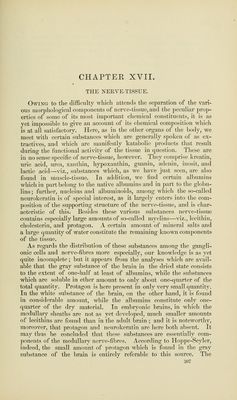
![The fat is deposited not only in the interfibrillary connective tissue, but also in the sarcoplasra proper, and is apparently more abundant in the red meat, which contains more sarcoplasm than in white meat. Like glycogen, it here represents a reserve source of muscular energy, but is apparently utilized more especially when a sufficient su])ply of the former or of grape-sugar, as such, is not available. While it is ordinarily derived from the ingested fats or from carbo- hydrates, there can be no doubt that under certain pathological condi- tions, which are associated with an increased destruction of tissue albumins, it can also originate from these. This question, however, we shall not consider in detail at this place, but shall revert to it in a future section. In addition to fats, muscle-tissue also contains a small amount of cholesterin, fats, and fatty acids, and at times considerable quanti- ties of lecithins (0.69 per cent.). The chemical composition of involuntary muscle-tissue is appar- ently similar to that of the striped variety. From the muscles of the stomach of the pig and goose Velichi obtained a spontaneously coagulating plasma, from which one albumin was precipitated on dialysis, while a second remained in solution. The first was solu- ble in dilute solutions of the neutral salts and was precipitated by acetic acid; it coagulated between 54° and 60° C. The second coagulated between 46° and 50° C In the holothurians, which probably represent one of the lowest forms of animal life in which an actual differentiation of proto- plasm to muscle-tissue has occurred, the tissue is apparently of the unstriped variety. In stictopus, which belongs to this order, v. Fiirth was unable to isolate an albumin coagulating below 50° C, while Krukenberg states that in the case of Holothuria tubulosa his extraction liquid coagulated at 45° C.](https://iiif.wellcomecollection.org/image/b21207240_0406.jp2/full/800%2C/0/default.jpg)
 No text description is available for this image
 No text description is available for this image
 No text description is available for this image