A text-book of physiological chemistry : for students of medicine and physicians / by Charles E. Simon.
- Charles Edmund Simon
- Date:
- 1904
Licence: Public Domain Mark
Credit: A text-book of physiological chemistry : for students of medicine and physicians / by Charles E. Simon. Source: Wellcome Collection.
Provider: This material has been provided by the Augustus C. Long Health Sciences Library at Columbia University and Columbia University Libraries/Information Services, through the Medical Heritage Library. The original may be consulted at the the Augustus C. Long Health Sciences Library at Columbia University and Columbia University.
437/532 page 427
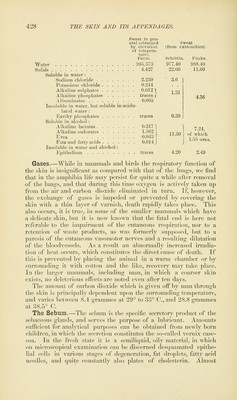
![sensations and emotions, by stimulation of the sciatic nerve, follow- ing the administration of pilocarpin, etc. Ordinarily the secretion of sweat is scarcely noticeable, as the droplets evaporate almost as rapidly as they appear on the sur- face of the skin. But even so, from 700 to 900 c.c. of water are daily eliminated by the body. Artificially this amount can be greatly increased, and it is stated that from <iOOO to 8000 c.c. may be excreted in the twenty-four hours if the body is kept at a tem- perature of from 40° to 50° C, and large amounts of fluid are ingested. Sweat, recently secreted, is more or less turbid, owing to an admix- ture of desquamated epithelial cells, and droplets of fat, which are in part derived from the sebaceous glands, but are to some extent also referable to the sweat-glands proper. After filtration it appears as a clear, transparent, colorless fluid, of a salty, somewhat acrid taste, and a very characteristic odor, which differs somewhat according to the region of the body from which the sweat is derived. Its specific gravity varies between 1.004 and 1.005. At the beginning of its secretion the sweat presents an acid reac- tion, which is probably referable to an admixture of fatty acids derived from the sebaceous glands ; later, however, it is alkaline. Under normal conditions the sweat is essentially a very dilute aqueous solution of mineral salts, but in addition we also find small amounts of many urinary components, such as urea, uric acid, kreatinin, aromatic oxy-acids, volatile fatty acids, skatoxyl and phenol sulphate, besides fat, cholesterin, traces of albumin, salts of lactic acid, and so-called sudoric or hydratic acid, etc. Larger amounts of solids are principally met with in cases of renal insuffi- ciency, and it may then hap])en that the elimination of urea through the sweat increases to 10 grammes, as compared with 0.043-1.55 pro mille, which may be regarded as normal. In some cases of this kind the urea may actually be found in the form of a fine cry- stalline powder deposited all over the skin. Glucose has been observed in diabetes. Cystin has been noted in cases of cystinuria, and abnormally large amounts of uric acid have been found in gout. In jaundice bilirubin may color the sweat a bright yellow. A blue and red color, which is thought to be referable to the presence of indigo-blue and indigo-red, has also been observed (chromhidrosis or cyanhidrosis) ; and it is stated that in rare instances blood may appear in the sweat (hsemahidrosis). It is noteworthy, furthermore, that a number of foreign substances, when ingested by the mouth, such as quinin, the various salts of iodine, mercury, and arsenic, are in part eliminated in the S'vi'^eat. A general idea of the quantitative composition of the sweat may be formed from the accompanying analyses, which are taken from Favre, Sch5ttin, and Fiinke.](https://iiif.wellcomecollection.org/image/b21207240_0437.jp2/full/800%2C/0/default.jpg)
 No text description is available for this image
 No text description is available for this image
 No text description is available for this image