The configuration of tropine and [psi]-tropine and the resolution of atropine / by Marmaduke Barrowcliff and Frank Tutin.
- Barrowcliff, Marmaduke.
- Date:
- [1909?]
Licence: In copyright
Credit: The configuration of tropine and [psi]-tropine and the resolution of atropine / by Marmaduke Barrowcliff and Frank Tutin. Source: Wellcome Collection.
10/16 page 1973
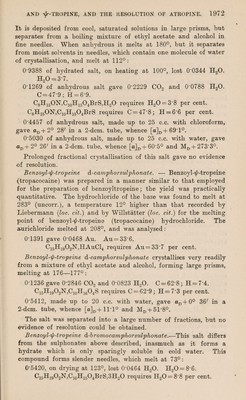
![The anhydrous salt crystallises readily from a mixture of ethy! acetate and alcohol, and forms thin prisms, which melt at 190°: 0*1401 gave 0*2779 C02 and 0*0794 H20. C = 54*l; H = 6*3. C15H19O2N,C10H15O4BrS requires C = 54*0; H = 6*l per cent. 0*4827, made up to 20 c.c. with water, gave aD + 2° 17r in a 2-dcm. tube, whence [a]D + 47*3° and MD + 262*9°. This result for the molecular rotatory power is rather lower than would have been expected for the bromocamphorsulphonate of an inactive base. Nevertheless, the base was devoid of optical activity,, and the discrepancy can only be ascribed to the fact that the solutions examined were highly supersaturated. The salt was separated by crystallisation into a number of fractions, but all of these had the same rotatory power and melting point. Tropinone. Tropine and i/'-tropine were each separately oxidised to tropinone, according to the method described by Willstatter (Ber., 1896, 29, 393), and the resulting base purified by means of the pierate. Willstatter states that this salt melts at 220°, but the present authors find that the temperature of fusion is dependent on the rate of heating, and may lie at any point from 210—250°. Each pre¬ paration of the base was converted into the d-camphorsulphonater when the resulting salts were found to be in all respects identical. Tropinone e?-camphorsulphonate is fairly readily soluble in dry ethyl acetate, from which it crystallises in moss-like growths, apparently composed of needles; it melts and decomposes at 216°: 0*1130 gave 0*2421 C02 and 0*0830 H20. C = 58*4; H = 8*l. C8H13ON,C10H16O4S requires C = 58*2; 11 = 7*9 per cent. The salt is much less soluble in ethyl acetate which has not been specially dried, and crystallises from this solvent in tufts of leaflets, which, when rapidly heated, suddenly lose water of crystallisation at 140°, but without completely melting: 2*0429, on heating at 123°, lost 0*0939 H20. H20 = 4*6. C8H13ON,C10H16O4S,H2O requires H20 = 4*6 per cent. The hydrated salt appears to be dimorphous, since, at low tem¬ peratures, it crystallises from a mixture of ethyl acetate and dilute alcohol in long, slender prisms. No resolution of tropinone d-camphorsulphonate could be effected by fractional crystallisation.](https://iiif.wellcomecollection.org/image/b30614181_0010.jp2/full/800%2C/0/default.jpg)




 No text description is available for this image
 No text description is available for this image
 No text description is available for this image