The configuration of tropine and [psi]-tropine and the resolution of atropine / by Marmaduke Barrowcliff and Frank Tutin.
- Barrowcliff, Marmaduke.
- Date:
- [1909?]
Licence: In copyright
Credit: The configuration of tropine and [psi]-tropine and the resolution of atropine / by Marmaduke Barrowcliff and Frank Tutin. Source: Wellcome Collection.
12/16 page 1975
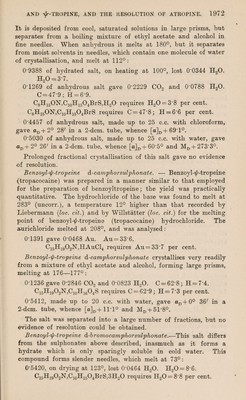
![It would appear, therefore, that the respective bases contained in the above-described pure d-camphorsulphonates have a specific rotation of [a]D±32'l°, a value considerably higher than that usually given for hyoscyamine (about —21*0°). It was, however, found impossible to obtain directly from either of the camphor- sulphonates in question a base of higher specific rotatory power than about [a]D + 20'0°, even when the greatest care was taken to avoid racemisation. That this change, nevertheless, had occurred to some extent was shown by reconverting a quantity of the base having [a]D — 20*0° into the d-camphorsulphonate, when a somewhat impure salt was obtained, from which the derivative of a dextro- base was separated. A considerable quantity of the lsevo-base, having [a]D — 20*2°, was fractionally crystallised from petroleum (b. p. 90—120°), when a fraction was eventually obtained which melted at 107—108°, and had the following rotatory power: 0*4331, made up to 20 c.c. with 50 per cent, alcohol, gave aD — 1° 1' in a 2-dcm. tube, whence [a]D —25*8°. This is a higher value than has heretofore been observed for the rotation of hyoscyamine. ^-Hyoscyamine, obtained from its d-camphorsulphonate, was in all respects analogous to its optical antipode. As it appears probable from the above results that optically pure hyoscyamines have never been obtained in a free state, several salts of these bases were prepared by double decomposition from the pure d-camphorsulphonates. Corresponding salts of atropine have also been made for the purpose of comparison. The Aurichlorides.—Z-Hyoscyamine aurichloride has previously been described as forming leaflets, melting at 162° (Will, Btr., 1888, 21, 1717). The pure salt forms golden-yellow, hexagonal plates, which melt at 165°, and are anhydrous : 0*1244 gave 0*0391 Au. Au = 31*35. C17H2303N,HAuC14 requires Au = 31*35 per cent. ^-Hyoscyamine aurichloride is much more soluble in alcohol than in water, but can readily be crystallised from the former solvent. Somewhat impure ^-hyoscyamine aurichloride was prepared by Amenomiya (loc. cit.). The pure salt crystallises similarly to its optical antipode, melts at 165°, and is anhydrous: 0*1198 gave 0*0374 Au. Au = 31*22. C17H2303N,HAuC14 requires Au = 31*35 per cent. Atropine aurichloride showed some tendency to separate as an oil, but crystallised fairly readily. It formed tufts of very small, anhydrous leaflets, which melted at 134—1139°: 0*0926 gave 0*0292 Au. Au = 31*5. C17H2303N,HAuC14 requires Au = 31*35 per cent.](https://iiif.wellcomecollection.org/image/b30614181_0012.jp2/full/800%2C/0/default.jpg)




 No text description is available for this image
 No text description is available for this image
 No text description is available for this image