The configuration of tropine and [psi]-tropine and the resolution of atropine / by Marmaduke Barrowcliff and Frank Tutin.
- Barrowcliff, Marmaduke.
- Date:
- [1909?]
Licence: In copyright
Credit: The configuration of tropine and [psi]-tropine and the resolution of atropine / by Marmaduke Barrowcliff and Frank Tutin. Source: Wellcome Collection.
7/16 page 1970
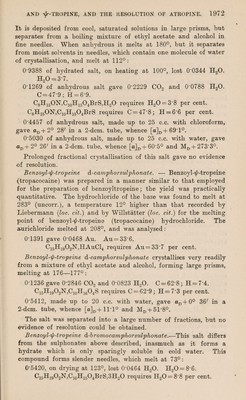
![by the resolution of atropine. It has thus been rendered evident that the two optical antipodes have, qualitatively, essentially the same physiological action, and differ only in the intensity of their effects. The ratio of activity of the l- to the d-isomeride has been found, however, when employing the pure salts, to be much greater than was indicated by Cushny. Thus, the mydriatic action of the former base was found to be about one hundred times that of the latter, wdiilst the paralysis of the vagus induced by them was in the ratio of 25 : 1, or possibly rather greater. Experimental. Tr opine. Trapine d-camphorsulphonate.—This salt is very readily soluble in water or alcohol. It crystallises well, however, from a mixture of alcohol and ethyl acetate, or from chloroform, giving large, tabular crystals, melting at 236°: 0-1138 gave 0'2408 C02 and 0-0871 H20. C = 57'7; H = 8*5. C8H15ON,C10H16O4S requires C = 57-9; H = 8*3 per cent. The salt was fractionally crystallised under various conditions, but no appreciable difference could be detected between any of the resulting fractions: 0*3761, made up to 25 c.c. with chloroform, gave aD + 0° 587 in a. 2-dcm. tube, whence [a]D + 32l°. 0*4123, made up to 25 c.c. with water, gave aD + 0° 27' in a 2-dcm. tube, whence [a]D+13*6° and MD-f50*6°. Benzoyltropeine d-camphorsulphonate.—Benzoyltropeine was pre¬ pared by Ladenburg (Annalen, 1883, 217, 82) by the interaction of tropine and benzoic acid. An improved method of preparation has recently been described by Jowett and Pyman (this vol., p. 1028), who heated tropine hydrochloride with benzoyl chloride, thereby obtaining 77 per cent, of the theoretical yield of benzoyltropeine hydrochloride. The present authors, however, found that a prac¬ tically theoretical yield of the latter salt could be obtained in a few minutes by employing free tropine instead of its hydrochloride. The base was added to an excess of benzoyl chloride, and the mixture heated to the boiling point of the latter. An additive compound of the base and the acid chloride, analogous to the corresponding compound obtained from pyridine, appeared first to be formed, but, when the temperature was raised, this soon re¬ dissolved, whereupon the hydrochloride of the benzoylated base rapidly separated. The cooled mixture was then diluted with ether, and the hydrochloride collected. After being once crystal¬ lised from alcohol, it melted and decomposed at 267° (uncorr.).](https://iiif.wellcomecollection.org/image/b30614181_0007.jp2/full/800%2C/0/default.jpg)




 No text description is available for this image
 No text description is available for this image
 No text description is available for this image