The influence of timbre and loudness on the localization of sounds / by Charles S. Myers.
- Charles Samuel Myers
- Date:
- [1914?]
Licence: In copyright
Credit: The influence of timbre and loudness on the localization of sounds / by Charles S. Myers. Source: Wellcome Collection.
3/22
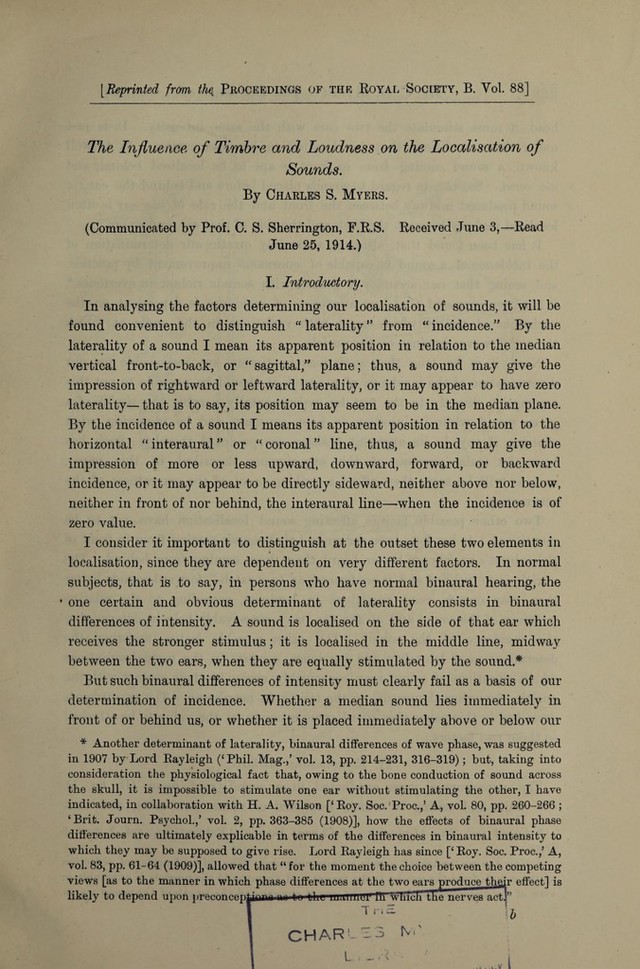
![The Influence of Timbre and Loudness on the Localisation of Sounds. By Charles S. Myers. (Communicated by Prof. C. S. Sherrington, F.R.S. Received June 3,—Read June 25, 1914.) I. Introductory. In analysing the factors determining our localisation of sounds, it will be found convenient to distinguish “ laterality ” from “ incidence.” By the laterality of a sound I mean its apparent position in relation to the median vertical front-to-back, or “ sagittal,” plane; thus, a sound may give the impression of rightward or leftward laterality, or it may appear to have zero laterality— that is to say, its position may seem to be in the median plane. By the incidence of a sound I means its apparent position in relation to the horizontal “ interaural ” or “ coronal ” line, thus, a sound may give the impression of more or less upward, downward, forward, or backward incidence, or it may appear to be directly sideward, neither above nor below, neither in front of nor behind, the interaural line—when the incidence is of zero value. I consider it important to distinguish at the outset these two elements in localisation, since they are dependent on very different factors. In normal subjects, that is to say, in persons who have normal binaural hearing, the • one certain and obvious determinant of laterality consists in binaural differences of intensity. A sound is localised on the side of that ear which receives the stronger stimulus; it is localised in the middle line, midway between the two ears, when they are equally stimulated by the sound.* But such binaural differences of intensity must clearly fail as a basis of our determination of incidence. Whether a median sound lies immediately in front of or behind us, or whether it is placed immediately above or below our * Another determinant of laterality, binaural differences of wave phase, was suggested in 1907 by Lord Rayleigh (‘Phil. Mag.,’ vol. 13, pp. 214-231, 316-319) ; but, taking into consideration the physiological fact that, owing to the bone conduction of sound across the skull, it is impossible to stimulate one ear without stimulating the other, I have indicated, in collaboration with H. A. Wilson [‘Roy. Soc.'Proc.,’ A, vol. 80, pp. 260-266 ; ‘Brit. Journ. Psychol.,’ vol. 2, pp. 363-385 (1908)], how the effects of binaural phase differences are ultimately explicable in terms of the differences in binaural intensity to which they may be supposed to give rise. Lord Rayleigh has since [‘ Roy. Soc. Proc.,’ A, vol. 83, pp. 61-64 (1909)], allowed that “ for the moment the choice between the competing views [as to the manner in which phase differences at the two ears produce their effect] is likely to depend upon ■ *1 ‘1|“ w m T ric. b CHARt N L. , - 1.V](https://iiif.wellcomecollection.org/image/b30620727_0003.jp2/full/800%2C/0/default.jpg)