Rudimentary treatise on the construction of cranes, and machinery for raising heavy bodies, for the erection of buildings, and for hoisting goods / By Joseph Glynn.
- Joseph Glynn
- Date:
- 1849
Licence: Public Domain Mark
Credit: Rudimentary treatise on the construction of cranes, and machinery for raising heavy bodies, for the erection of buildings, and for hoisting goods / By Joseph Glynn. Source: Wellcome Collection.
144/170 (page 94)
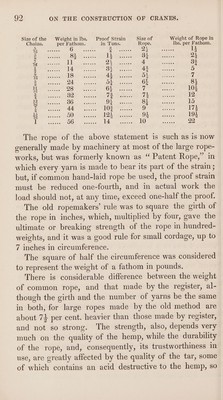
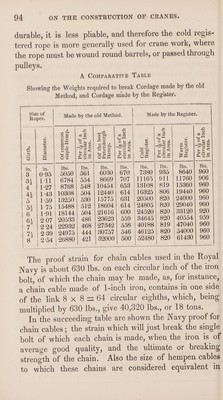
![durable, it is less pliable, and therefore the cold regis- tered rope is more generally used for crane work, where the rope must be wound round barrels, or passed through pulleys. A CoMPARATIVE TABLE Showing the Weights required to break Cordage made by the old Method, and Cordage made by the Register. : : Size of Ropes. Made by the old Method. Made by the Register. Inch Ineh \ of a 3 I ofa 4 7 in Area. Girth. Diameter. 3 He He CO OD vie Nie — ae — vie es OVI SW moro tos] 2:07 2-24 2°39 2°54 ee ind SES? O Gr Ox ae Of common staple Hemp. Per th of a eireular Petersburgh Of the best Hemp- — nu n 603 8669 10454 12440 15775 18604 21616 23623 27342 30757 32000 Per 15 ofa circular in Area. Per circular Ine in Area. Per circular Inch in Area. The proof strain for chain cables used in the Royal Navy is about 630 Ibs. on each circular inch of the iron bolt, of which the chain may be made, as, for instance, a chain cable made of 1-inch iron, contains in one side of the link 8 x 8 = 64 circular eighths, which, being multiplied by 630 lIbs., give 40,320 lbs., or 18 tons. In the succeeding table are shown the Navy proof for chain cables; the strain which will just break the single bolt of which each chain is made, when the iron is of average good quality, and the ultimate or breaking strength of the chain. Also the size of hempen cables to which these chains are considered equivalent in](https://iiif.wellcomecollection.org/image/b33027924_0144.jp2/full/800%2C/0/default.jpg)