Rudimentary treatise on the construction of cranes, and machinery for raising heavy bodies, for the erection of buildings, and for hoisting goods / By Joseph Glynn.
- Joseph Glynn
- Date:
- 1849
Licence: Public Domain Mark
Credit: Rudimentary treatise on the construction of cranes, and machinery for raising heavy bodies, for the erection of buildings, and for hoisting goods / By Joseph Glynn. Source: Wellcome Collection.
39/170 (page 25)
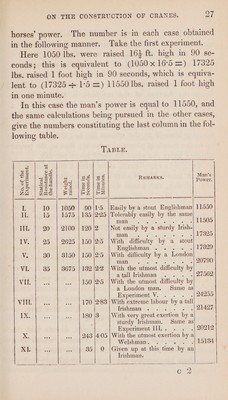
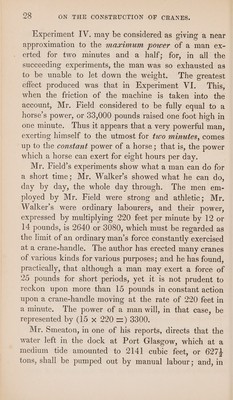
![and horses to load and remove the largest timber trees and blocks of stone which their waggon is capable of carrying. The machinery used in such cases when men’s power is applied, is generally a windlass and a pair of three-fold blocks, the windlass being fixed to two of the “legs.” When horses are employed, the rope from the blocks or “tackle fall” is passed through a leading block or “snatch block” attached to one of the legs, in order to give the rope a horizontal direction, and the horses being yoked to it, gaining by the threefold blocks a power of six to one, can raise great weights with much facility. The horses regularly engaged on such work display great sagacity and obedience to a word or sign, to hoist, to lower, or to stop. The power of horses has been already mentioned ; the power of men ‘is next to be considered. The late Mr. John Walker, an able assistant of Mr. Rennie, made many and repeated experiments on the power of men employed in raising weights for driving piles in the Royal Dockyard at Sheerness, and he found that the force exerted by an ordinary labourer, in average daily work, frequently did not exceed 12]bs., and that 14 bs. was as much as could be reckoned upon as the power of a labourer working daily at a winch or crane handle, for ten hours a day, moving at the rate of 220 ft. per minute. It is important to remember facts like this, because most writers rate the power of men much higher. This is an error into which they were likely to fall when manual force was exerted for the purposes of expe- riment, for a short period, or even for a single day. Mr. Joshua Field (now President of the Institution of Civil Engineers) some years ago tried a series of ex- periments on the strength of men working at a crane C](https://iiif.wellcomecollection.org/image/b33027924_0039.jp2/full/800%2C/0/default.jpg)