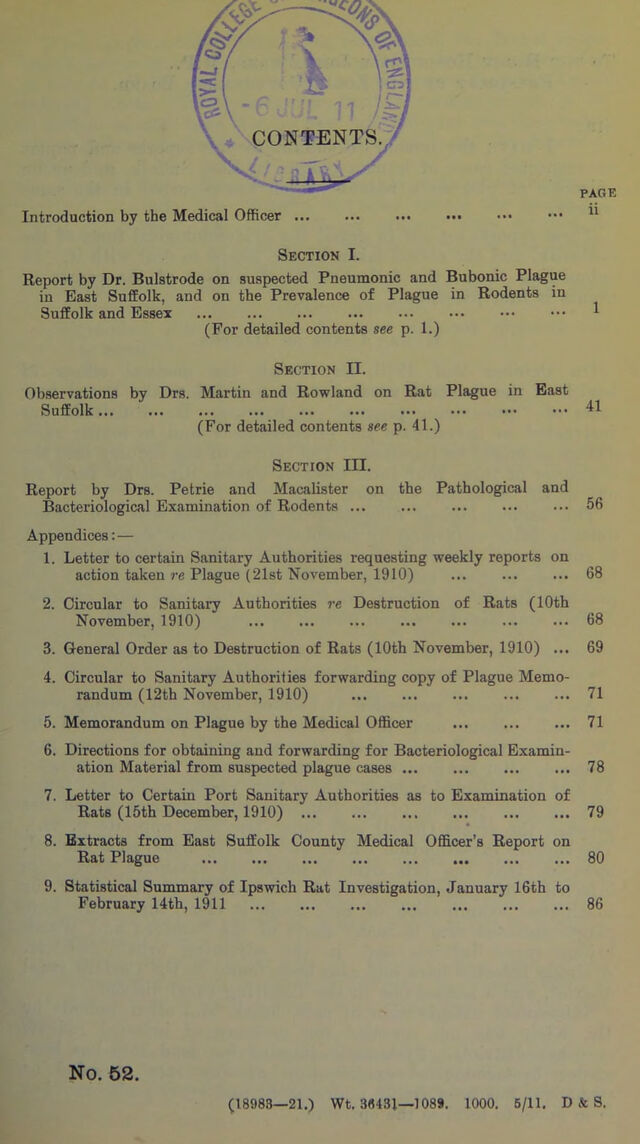
Reports and papers on suspected cases of human plague in East Suffolk and on an epizootic of plague in rodents.
- Date:
- 1911
Licence: In copyright
Credit: Reports and papers on suspected cases of human plague in East Suffolk and on an epizootic of plague in rodents. Source: Wellcome Collection.
Provider: This material has been provided by The Royal College of Surgeons of England. The original may be consulted at The Royal College of Surgeons of England.
102/104 page 84
![animals were found in the Samford Rural District, and in the area limited by the North, West, and water boundaries of the Woodbridge Rural District. Work done by the District Councils. The reports received from the Medical Officers of Health as to the steps taken by their Councils up to December 31st, 1910, and other matters, in accordance with the requirements of one of the resolutions passed at the County Conference on December 20th, 1910, will be found at the end of this report. A short summary of the information is now given, with a few details not furnished elsewhere. Two District Authorities within the County took steps to destroy rats dxiring October, 1910, Samford and Felixstowe. The Samford Rural District Council, co-operating with the Ipswich Borough Public Health Committee, commenced in the middle of October. The Felix.stowe and Walton Urban Council took energetic steps on October 29th. During November and December all the District Councils evidenced a greater or less activity in the matter. Tlie Urban Councils, taken as a whole, have responded well. To tlie end of December, 1910, three of these (Fye, Halesworth, and Oulton Broad) only issued warning notices and sent out notices to owners and occupiers of i)ioperty urging destriiction of rats. 'I’lie remaining ten Urban Councils did all this, and in addition took more active steps, whicli will bo found detailed by the ^ledical Officers in their reports. In the rural areas the Councils are undoubtedly faced with greater difficulties in the destruction of rats. The majority of the Councils have contented themselves with issuing warning notices and urging householders and others to destroy rats, but in many instances this has been followed up by repeated visits from the Public Health officials. Three of the Rural District Councils have taken more active steps; in the Wangford area a halfpenny per tail is paid for all dead rats brought to certain officials; the Plomesgate Council has had its area treated with Liverpool Virus; and in the Samford area from 20 to 30 rat catchers have been employed with great success. A most useful action of the latter Council was to supply all threshing-machine proprietors with wire netting, and to pay a small fee to fix it round all stacks threshed. Other Work. The Great Eastern Railway Com])any have shown great energy in the destruction of rats along their lines and in buildings belonging to them. At Shotley the Admiralty officials arranged for the services of a special rat catcher. From all parts of the County we hear of the active work under- taken by private individuals. A large amount of time and money has been expended by them in the destruction of rats. They make one complaint, a very pertinent one; it is that their work is of small permanent avail because of the apathy of their](https://iiif.wellcomecollection.org/image/b22431937_0104.jp2/full/800%2C/0/default.jpg)