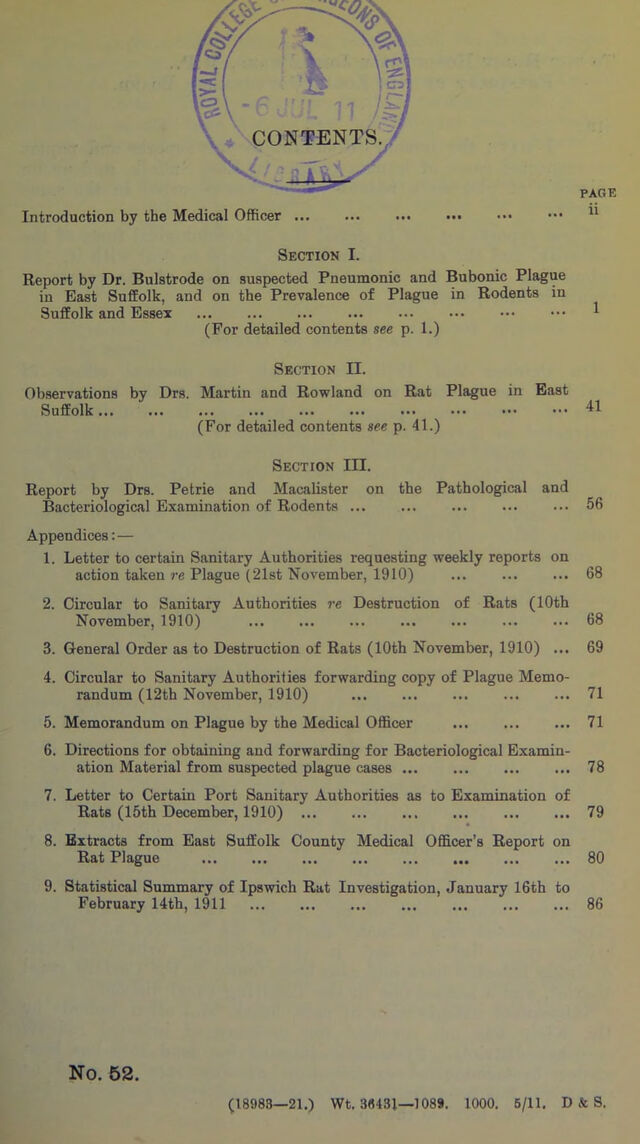
Reports and papers on suspected cases of human plague in East Suffolk and on an epizootic of plague in rodents.
- Date:
- 1911
Licence: In copyright
Credit: Reports and papers on suspected cases of human plague in East Suffolk and on an epizootic of plague in rodents. Source: Wellcome Collection.
Provider: This material has been provided by The Royal College of Surgeons of England. The original may be consulted at The Royal College of Surgeons of England.
16/104 page 4
![Symptoms and Physical Signs in the Several Cases. For my information relative to the cases I am indebted to notes from Dr. Carey and Dr. Sleigh, one or other of whom attended the cases, to Dr. Herbert Brown, whose assistance was sought in consultation, and to Dr. Heath, who carried out the bacterio- logical investigations, and the accounts which follow are based partly upon the notes and information thus furnished me and partly upon two papers contributed to the British Medical Journal.* The child, A. G., aged 9, who was the first inmate to he attacked had some eight days previously returned from a cottage at Hence Park Farm, Harkstead, where she had been staying with relatives. This farm is situated in an isolated position near the middle of the Samford peninsula, about midway between the villages of Hark.stead and Firwarton, but a little to the north thereof (see map). This child was taken ill on September 12th with vomiting, and when seen next day by Dr. Carey, of Holbrook, she had a temperature of 105°. No dulness was detected over the lungs and there was no cough; breathing was then normal. Next day the child’s general condition appeared unchanged, but on the following day, Se])teinber 15th, rales were detected over the base of both lungs and the breathing was accelerated. During the night the child coughed up some blood and suffered from diarrluea and vomiting. There was also some delirium. The child died on the morning of Re])tember 16th, the teini)erature having throughout the illness maintained a level of about 105°. Death was certified as due to “ Gastric Catarrh and Pneumonia.” Mrs. C. (the mother), ag(*d 40, who mirsed the foregoing ca.se, was taken ill on the night of Wednesday, September 21st, with headache and nausea, and when .seen by Dr. Carey on the afternoon of the following day she had a temperature of nearly 105°, with crej)itation at the base of both lungs, and during the night there was much vomiting and diarrhoea. On the following morning, Seidember 2Mrd, her breathing was very rapid, laboured, and ga.sping, and her pulse imperceptible. She died the same day, the cause of death being recorded as “ Septic Pneumonia.” Some sputum from this cuse was collected for bacterio- logical examination by Dr. Herbert Brown, of Ii)swich, who was asked by Dr. Carey to see the case. This sputum, which did not resemble pneumonic sputum, was brownish in colour and presented the appearance of being tinged with Anchovy sauce. It was examined by Dr. Heath, bacteriologist to the Ipswich and East Sxiffolk Hospital, who found in it pneu- mococci and gram-negative diplobacilli in large numbers. ” (a) Four cases of Pneumonic Plague, by H. P. Sleigh, M.D.; (b) the Recent Plague Cases in Suffolk, by Herbert H. Brown, M.D., F.R.C.S., British Medirai Jntirmd, Nov. 12, 1910.](https://iiif.wellcomecollection.org/image/b22431937_0018.jp2/full/800%2C/0/default.jpg)