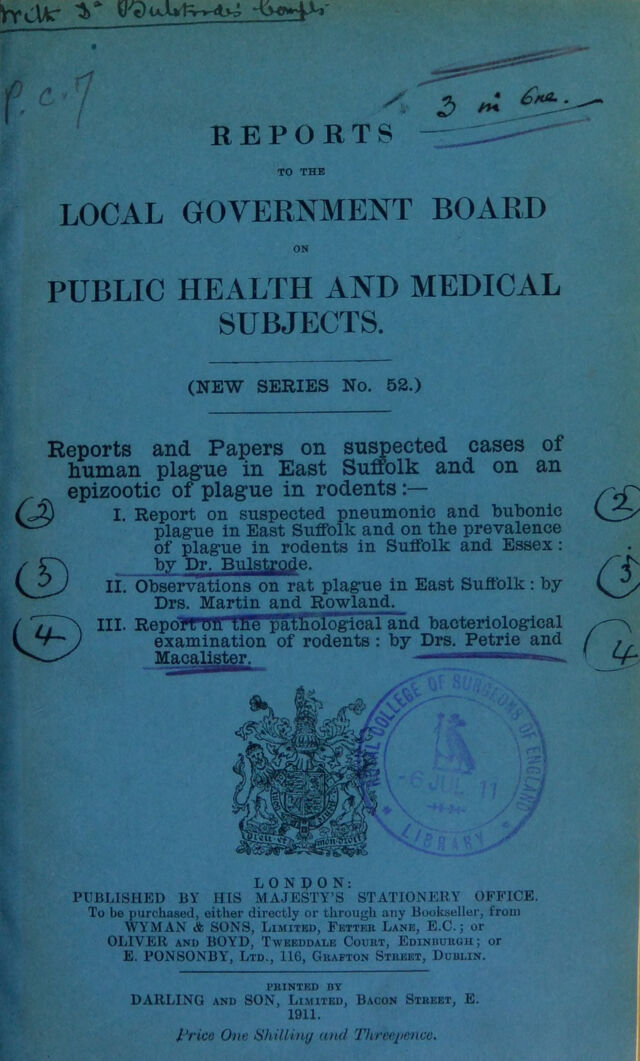
Reports and papers on suspected cases of human plague in East Suffolk and on an epizootic of plague in rodents.
- Date:
- 1911
Licence: In copyright
Credit: Reports and papers on suspected cases of human plague in East Suffolk and on an epizootic of plague in rodents. Source: Wellcome Collection.
Provider: This material has been provided by The Royal College of Surgeons of England. The original may be consulted at The Royal College of Surgeons of England.
49/104 page 37
![before she, H. E., left for the hospital on January 22nd, and at a time when she was actually ill. This would involve an incuba- tion period of 12 days. It may be said at once that this interval is too long-, except in the very unlikely event of the disease liaving taken the form of what is known as pestis minor, and then, owing to some sudden loss of resisting power on the part of the patient, developing into typical plague. But in this instance there is no evidence whatever in support of this view. Eeverting now to further consideration of the whole group, the difficulty which presents itself is as to the channel or agents by which the disease spread from person to person. Bubonic plague is a disease which, so far as is known at present, spreads fi-ora rat to man by the agency of the rat flea and not otherwise, and upon this assumption there is considerable difficulty in accounting for the whole of the present series of cases. It was not possible to ascertain that any dead rats had been heard of in the neighbourhood of the invaded houses at Trimley, but, on the otlier hand, it may be confldently stated that plague amongst rats was extensively spread over many parts of the Woodbridge union, whicli comprises Trimley, and rats, dead of plague, were found in Trimley parish in the autumn of 1910. It requires, therefore, no great stretcli of the imagi- nation to suppo.se that ])lague vats may have existed at Trimley during the time of the outbreak of illness with which we are now dealing, and that such rats may have ohtoined access to the house or to some of the outhouses connected therewith. On this as.suniption, the cases which arise in the house may have been diie, each one, to rat-flea infection, or there may possibly have been some transference of infected rat fleas from case to case. It is, too, by no means inconceivable that in the series of cases Pulex irritans may have been the agent by means of which infection was transmitted from case to case. Although the experience in India as regards bubonic plague is opposed to the communicability of the disease from case to case, the behaviour of the disease in this country in past epidemics raises the question whether case to case infection does not in some outbreaks manifest itself even with bubonic and septicsemic plague. Moreover, the remarkable experiments which were con- ducted by Dr. Verzbitski* in 1902-3, at Cronstadt and St. Peters- burg, show conclusively that Pulex irritans may live as a casual parasite on rats, and that the .stomach of these fleas may contain plague bacilli. Dr. Verzbitski found that human fleas and fleas found on cats and dogs are able to live on rats as casual parasites, and, therefore, that they can under certain conditions play a part in plague transmission from rats to human beings and vice versd. Verzbitski also showed, by his experimental work, that it was probable that, in addition to the direct part which infected insects can play in the spread of plague, the belongings and especially ® “Journal of Hygiene,” Vol. 8, No. 2, May, 1908. Fourth Extra Number containing Reports on Plague Investigations in India.](https://iiif.wellcomecollection.org/image/b22431937_0051.jp2/full/800%2C/0/default.jpg)