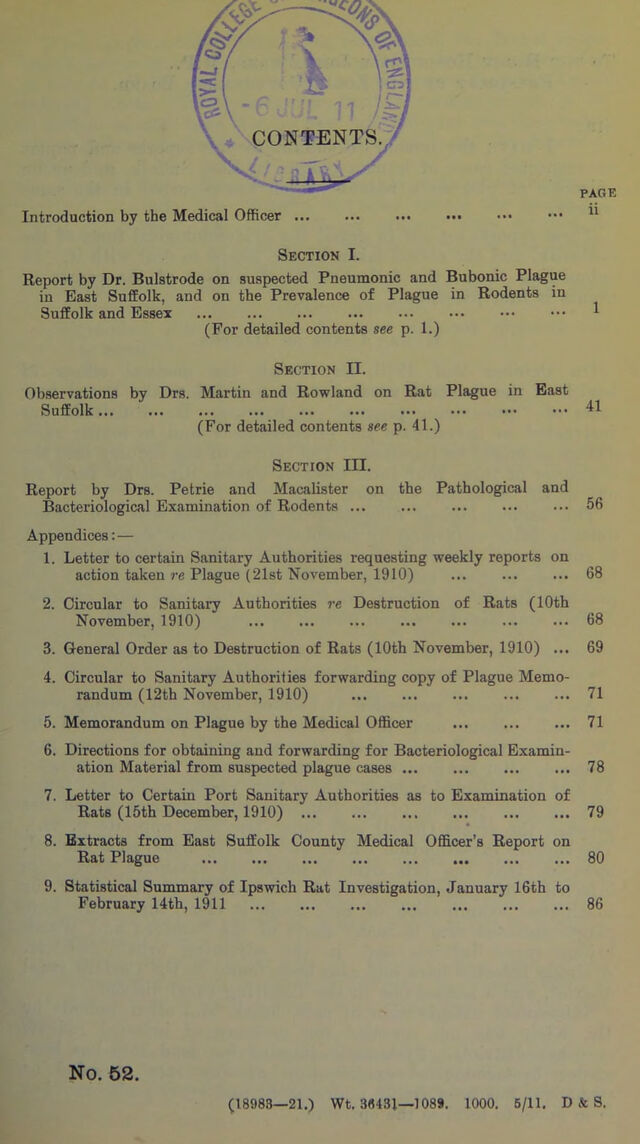
Reports and papers on suspected cases of human plague in East Suffolk and on an epizootic of plague in rodents.
- Date:
- 1911
Licence: In copyright
Credit: Reports and papers on suspected cases of human plague in East Suffolk and on an epizootic of plague in rodents. Source: Wellcome Collection.
Provider: This material has been provided by The Royal College of Surgeons of England. The original may be consulted at The Royal College of Surgeons of England.
56/104 page 42
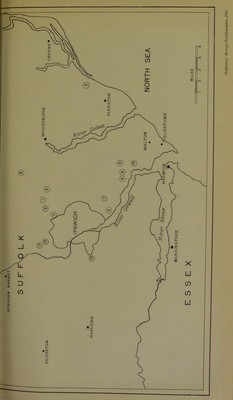
![lu additiou, a couple of hares, oue from Mistley and auother from as fai’ west as Edwai'dstoue, were proved to have died of the disease. The w'hole circumstances of the outbreak of rat-plague were under investigation by the Local Government Board, and the portion of the enquiry dealing with the nature, habits, and parasites of the rats in this district was assigned to us. Inci- dentally, however, we secured, in certain localities, a good many live rats which were found to be infected with plagiie. The discovery of these rats, together with information gleaned from local sources, and the observations of Dr. Heath and Professor Klein, enable some estimate of the extent and severity of the epizootic to be formed. Our first series of observations extended over 14 days, from the 8th to the 22nd of November. On December 27th we again visited the district and si)eiit six days at Hollesley Bay. This locality showed every indication of being heavily infected when we were there early in November, and we wished to ascertain what changes, if any, had taken place with the onset of the cold weather, both with regard to tlie dis- tribution of tlie rat population and to the prevalence of the disease amongst them. Further, it was the only locality where we had discovered a i)lague-infected raltbit, and it seemed advisable to pursue the enquiry in tins direction. For the invaluable help we received from the medical officers to the Board, from Dr. Heath, county medical officer. Dr. Pringle, M.O.H. for Ipswich, and also from the various ])ro])iietors upon whose land we worked, we wish to tender our best thanks. Mkthou of Enquiry. Tlie necessary laboratory equipment was conveyed to the scene of operation in a small motor car. The rats were obtained by trapping over nigiit and ferretting during the day. Immediately after killing, they were placed in large tins containing chloroform vapour to anajsthetise the fleas and facilitate their capture. As each tin was filled, it was brought to an extemporised laboratory in some barn or outhouse near by. Each rat was first examined for fleas. Tliey were counted and, after a iirovisioual examination, reserved tor future identification. Tlie rat was then dissected and examined for any naked eye appearances of plague, e.g., buboes, subcutaneous injection, or hiemorrhage from small vessels, peculiar mottling of the liver, enlarged spleen, and pleural effusion. If, from the above examination, there was any reason to suspect plague infection, microscopical preparations were made from the enlarged glands, and from the organs, and examined forthwith for the presence of B. pestis. If the post-mortem and microscopical examina- tion were so characteristic as to leave no doubt that the animal was infected with plague, cultures from the organs were not necessarily taken. Cultures were, however, taken from at least one of the rats diagnosed as plague-infected in each locality; these were submitted to cultural tests and inoculated into animals](https://iiif.wellcomecollection.org/image/b22431937_0058.jp2/full/800%2C/0/default.jpg)