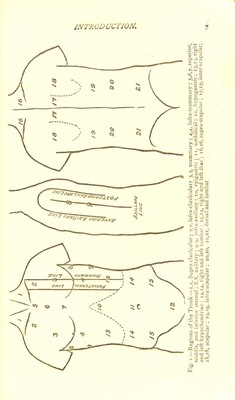
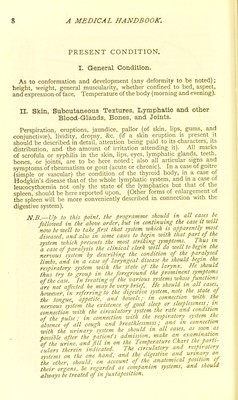
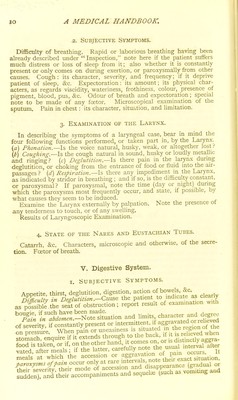
A medical handbook : for the use of practitioners and students / by R.S. Aitchison.
- Date:
- 1899
Licence: Public Domain Mark
Credit: A medical handbook : for the use of practitioners and students / by R.S. Aitchison. Source: Wellcome Collection.
Provider: This material has been provided by the Royal College of Physicians of Edinburgh. The original may be consulted at the Royal College of Physicians of Edinburgh.
27/402 (page 9)
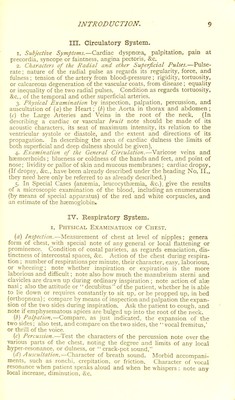
![in. Circulatory System. 1. Subjective Symptoms.—Cardiac dyspncea, palpitation, pain at precordia, syncope or faintness, angina pectoris, &c. 2. Characters of the Radial and other Superficial Pulses.—Pulse- rate ; nature of the radial pulse as regards its regularity, force, and fulness ; tension of the artery from blood-pressure ; rigidity, tortuosity, or calcareous degeneration of the vascular coats, from disease ; equality or inequality of the two radial pulses. Condition as regards tortuosity, &c., of the temporal and other superficial arteries. 3. Physical Examination by inspection, palpation, percussion, and auscultation of [a) the Heart; (b) the Aorta in thorax and abdomen ; (c) the Large Arteries and Veins in the root of the neck. (In describing a cardiac or vascular britit note should be made of its acoustic characters, its seat of maximum intensity, its relation to the ventricular systole or diastole, and the extent and directions of its propagation. In describing the area of cardiac dulness the limits of both superficial and deep dulness should be given). 4. Examination of the General Circulation.—Varicose veins and heemorrhoids ; blueness or coldness of the hands and feet, and point of nose; lividity or pallor of skin and mucous membranes; cardiac dropsy. (If dropsy, &c., have been already described under the heading No. II., they need here only be referred to as already described.) 5. In Special Cases (anasmia, leucocythasmia, &c.), give the results of a microscopic examination of the blood, including an enumeration (by means of special apparatus) of the red and white corpuscles, and an estimate of the hsemoglobin. IV. Respiratory System. I. Physical Examination of Chest. (a) Inspection.—Measurement of chest at level of nipples; genera form of chest, with special note of any general or local flattening or prominence. Condition of costal parietes, as regards emaciation, dis- tinctness of intercostal spaces, &c. Action of the chest during respira- tion ; number of respirations per minute, their character, easy, laborious, or wheezing; note whether inspiration or expiration is the more laborious and difficult; note also how much the manubrium sterni and clavicles are drawn up dui'ing ordinary inspiration ; note action of alas nasi; also the attitude or decubitus of the patient, whether he is able to lie down or requires constantly to sit up, or be propped up, in bed (orthopncea); compare by means of inspection and palpation the expan- sion of the two sides during inspiration. Ask the patient to cough, and note if emphysematous apices are bulged up into the root of the neck. (^) /'fl:^a^zo«.—Compare, as just indicated, the expansion of the two sides; also test, and compare on the two sides, the '' vocal fremitus,' or thrill of the voice. [c) Percussion.—Test the characters of the percussion note over the various parts of the chest, noting the degree and limits of any local hyper-resonance, or dulness, or crack-pot sound, [d] Auscultation.—Character of breath sound. Morbid accompani- ments, such as ronchi, crepitation, or friction. Character of vocal resonance when patient speaks aloud and when he whispers : note any local increase, diminution, &c.](https://iiif.wellcomecollection.org/image/b21935117_0027.jp2/full/800%2C/0/default.jpg)