Licence: Public Domain Mark
Credit: Fractures and dislocations. Source: Wellcome Collection.
Provider: This material has been provided by The University of Leeds Library. The original may be consulted at The University of Leeds Library.
26/548 (page 14)
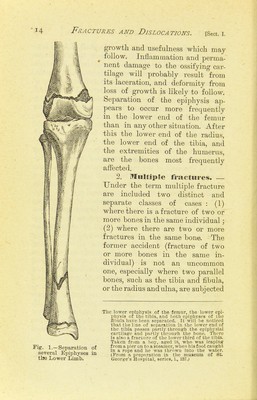
![(Sect. r. growth and usefulness which may follow. Inflammation and perma- nent damage to the ossifying car- tilage will probably i-esult from its laceration, and deformity from loss of growth is likely to follow. Separation of the epiphysis ap- X,-*'*] pears to occur more frequently in the lower end of the femur than in any other situation. After this the lower end of the radius, the lower end of the tibia, and the extremities of the humerus, are the bones most frequently affected. 2, inulti3>Bc fractures. — Under the term multiple fracture are included two distinct and separate classes of cases : (1) where there is a fracture of two or more bones in the same individual; (2) where there are two or more fractures in the same bone. The former accident (fracture of two or more bones in the same in- dividual) is not an uncommon one, especially where two parallel bones, such as the tibia and fibula, or the radius and ulna, are subjected Fig. 1.—Separation of several Epiphyses in the Lower Liml). The lower epiphysis of the feraur, the lower epi- physis of the tibia, and both epiphyses of the Simla have been separated. It will be noticed that the line of separation in the lower end of the tibia passes partly through the epiphysial cartilage and partly thnmo-h the bone. There is also a fracture of the lower third of the tibia. Taken from a boy, aged is, who was leaping from a pier on to a steamer, when his foot caught in a rope and he was thrown into the water. (From a prepfiration in the museum of St. George's Hospital, series, i., 187.;](https://iiif.wellcomecollection.org/image/b21518798_0026.jp2/full/800%2C/0/default.jpg)