Licence: Public Domain Mark
Credit: Fractures and dislocations. Source: Wellcome Collection.
Provider: This material has been provided by The University of Leeds Library. The original may be consulted at The University of Leeds Library.
516/548 page 504
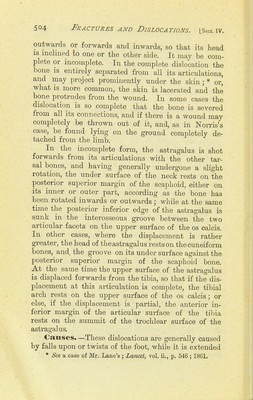
![outwards or forwards and inwards, so that its head IS inclined to one or the other side. It may be com- plete or incomplete. In the complete dislocation the bone IS entirely separated from all its articulations, and may project prominently under the skin; * or, what is more common, the skin is lacerated and the bone protrudes from the wound. In some cases the dislocation is so complete that the bone is severed from all its connections, and if there is a wound may completely be thrown out of it, and, as in Noms's case, be found lying on the ground completely de- tached from the limb. In the incomplete form, the astragalus is shot forwards from its articulations with the other tar- sal bones, and having generally undergone a slight rotation, the under surface of the neck rests on the posterior superior margin of the scaphoid, either on its inner or outer part, according as the bone has been rotated inwards or outwards ; while at the same time the posterior inferior edge of the astragalus is sunk in the interosseous groove between the two articular facets on the upper surface of the os calcis. In other cases, where the displacement is rather greater, the head of theastragalus rests on the cuneiform bones, and the groove on its under surface against the posterior superior margin of the scaphoid bone. At the same time the upper surface of the astragalus is displaced forwards from the tibia, so that if the dis- placement at this articulation is complete, the tibial arch rests on the upper surface of the os calcis; or else, if the displacement is partial, the anterior in- ferior margin of the articular surface of the tibia rests on the summit of the trochlear surface of the astragalus. Causes. —These dislpcations are generally caused by falls upon or twists of the foot, while it is extended * See a case of ]\Ir. Lane's ; Lancet, vol. ii., p. 546 ; 1861.](https://iiif.wellcomecollection.org/image/b21518798_0516.jp2/full/800%2C/0/default.jpg)