On the occurrence of heterotypical mitoses in cancer / by E.F. Bashford and J.A. Murray.
- Bashford, Ernest Francis, 1873-
- Date:
- 1906
Licence: In copyright
Credit: On the occurrence of heterotypical mitoses in cancer / by E.F. Bashford and J.A. Murray. Source: Wellcome Collection.
Provider: This material has been provided by The Royal College of Surgeons of England. The original may be consulted at The Royal College of Surgeons of England.
8/14 page 231
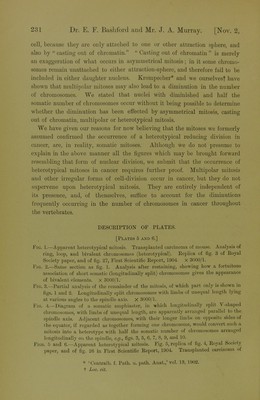
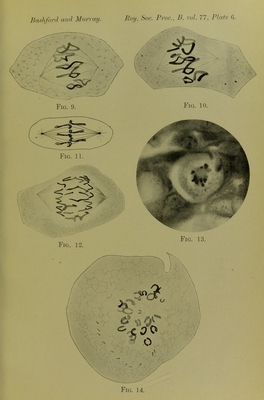
![cell, because the)' are only attached to one or other attraction sphere, and also by “ casting out of chromatin.” “ Casting out of chromatin ” is merely an exaggeration of what occurs in asymmetrical mitosis; in it some chromo- somes remain unattached to either attraction-sphere, and therefore fail to be included in either daughter nucleus. Krompecher* and we ourselvesf have shown that multipolar mitoses may also lead to a diminution in the number of chromosomes. We stated that nuclei with diminished and half the somatic number of chromosomes occur without it being possible to determine whether the diminution has been effected by asymmetrical mitosis, casting out of chromatin, multipolar or heterotypical mitosis. We have given our reasons for now believing that the mitoses we formerly assumed confirmed the occurrence of a heterotypical reducing division in cancer, are, in reality, somatic mitoses. Although we do not presume to explain in the above manner all the figures which may be brought forward resembling that form of nuclear division, we submit that the occurrence of heterotypical mitoses in cancer requires further proof. Multipolar mitosis and other irregular forms of cell-division occur in cancer, but they do not supervene upon heterotypical mitosis. They are entirely independent of its presence, and, of themselves, suffice to account for the diminutions frequently occurring in the number of chromosomes in cancer throughout the vertebrates. DESCRIPTION OF PLATES. [Plates 5 and 6.] Fig. 1.—Apparent lieterotypical mitosis. Transplanted carcinoma of mouse. Analysis of ring, loop, and bivalent chromosomes (lieterotypical). Replica of tig. 3 of Royal Society paper, and of fig. 27, First Scientific Report, 1904. x 3000/1. Fig. 2.—Same section as fig. 1. Analysis after restaining, showing how a fortuitous association of short somatic (longitudinally split) chromosomes gives the appearance of bivalent elements, x 3000/1. Fig. 3.—Partial analysis of the remainder of the mitosis, of which part only is shown in figs. 1 and 2. Longitudinally split chromosomes with limbs of unequal length lying at various angles to the spindle axis. X 3000/1. Fig. 4.—Diagram of a somatic amphiaster. in which longitudinally split V-shaped chromosomes, with limbs of unequal length, are apparently arranged parallel to the spindle axis. Adjacent chromosomes, with their longer limbs on opposite sides of the equator, if regarded as together forming one chromosome, would convert such a mitosis into a heterotype with half the somatic number of chromosomes arranged longitudinally on the spindle, e.g., figs. 3, 5, 6, 7, 8, 9, and 10. Figs. 5 and 6.—Apparent heterotypical mitosis. Fig. 5, replica of fig. 4, Royal Society paper, and of fig. 26 in First Scientific Report, 1904. Transplanted carcinoma of * ‘Centralb. f. Path. u. path. Anat.,’ vol. 13, 1902. t Loc. cit.](https://iiif.wellcomecollection.org/image/b22419317_0010.jp2/full/800%2C/0/default.jpg)