Lectures on physiology, zoology, and the natural history of man : delivered at the Royal College of Surgeons / by W. Lawrence.
- Sir William Lawrence, 1st Baronet
- Date:
- 1828
Licence: Public Domain Mark
Credit: Lectures on physiology, zoology, and the natural history of man : delivered at the Royal College of Surgeons / by W. Lawrence. Source: Wellcome Collection.
Provider: This material has been provided by the National Library of Medicine (U.S.), through the Medical Heritage Library. The original may be consulted at the National Library of Medicine (U.S.)
10/507
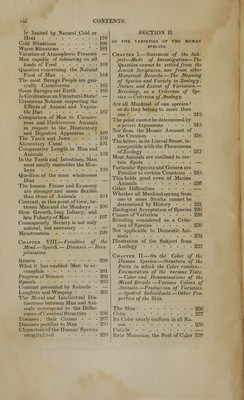
![Examples of Mechanical Powers - 68 Failure of Calculation as applied to the Circulation ----- 69 Chemistry; its useful Application to Physiology and Pathology - 70 General Utility of the Physical Sci- ences as a Branch of Medical Education 72 Import of the Expression, Vital Properties -74 Hypotheses respecting Life - - - 78 Comparative Anatomy - - - - 79 Its Importance in reference to Phy- siology 80 Examples 81 Necessary Caution in employing Arguments from Analogy - - 82 Lectitre IV.—Nature of Life.— Methodical Arrangement of Living Beings—Species, Varieties, Genera, Orders, fyc.—Progressive Simplifi- cation of Organization and Func- I tions.—Intellectual Functions of the \ Brain, in the natural and disordered state, explained on the same ■princi- ples as the offices of other Organs. Distinguishing Characters of Living Bodies 85 Great Variety of Forms - - - - 87 Species ------ — Individual Varieties of all Natural Productions - — Examples in the Human Mind, and consequent Absurdity of At- tempts at producing Uniformity of Actions and Opinions - - - 88 Varieties 89 Genera and Orders ----- 90 Classes and Departments - - - 91 Simplification of Organization - 92 Exemplified in the Four Depart- ments of the Animal Kingdom - — Exemplified in the Nervous System 94 Corresponding Modifications of Function - 95 The Mental Phenomena are the Functions of the Brain - Experience proves this, but does not show the Manner in which this Effect is produced - - - — The Size and Importance of the Brain are suited to this Office - 96 Proofs from the History of the Mind — Brain of the Homunculus - - - 97 Correspondence of Intellectual Phe- nomena and Cerebral Develope- ment in Animals - - An Immaterial Principle as neces- sary to them as to Man No other Office can be discovered for the Brain 100 Insanity proceeds from Disease of the Brain, as disturbed Func- tions in other Cases do from Dis- eases of the respective Organs - 101 Proof from Dissection - - - - 102 the Effect of Medical Treatment * 103 98 - 99 NATURAL HISTORY OF MAN. Chapter 1.—Nature and Objects of the Inquiry ; and Mode of Investiga- j tion—The Subject hitherto neglected, \ and, very erroneous notions conse- I qvently prevalent.—Sources of In- formation.—Anatomical Characters of the Monkey Tribe, and more par- \ ticularly of the Orang-utang and I Chimpansi.— Specific, Character of] Man. Extent and Importance of the Sub- ject - - 106 Hitherto comparatively neglected 107 Opinions of Monboddo and Rous- beap, respecting our Affinity to Monkeys 110 Supposed Gradation from Man to Animals - - - Ill The Writings of Buffon, Bihj;- enbach, and others; and par- ticularly ofDr. Pricharr - - 113 Linneus's Arrangement of Man — General Characters of the Quad- rumanous Mammalia - - -114 Simia Satyrus, or Orang-utang - 115 S. Troglodytes, or Chimpansc - 117 Zoological Character of Man - - — SECTION I. DISTINCTIONS BETWEEN MAN AND ANI- MALS, OR SPECIFIC CHARACTERS OF MAN. Chapter II.— The Erect Attitude of Man, and consequent Peculiarities in. the Structure of the Lower Limbs, Thorax, Spine, and Pelvis. The Erect attitude natural to Man 119](https://iiif.wellcomecollection.org/image/b21135915_0010.jp2/full/800%2C/0/default.jpg)