Licence: Public Domain Mark
Credit: Practical organic and bio-chemistry / by R.H.A. Plimmer. Source: Wellcome Collection.
617/660 page 597
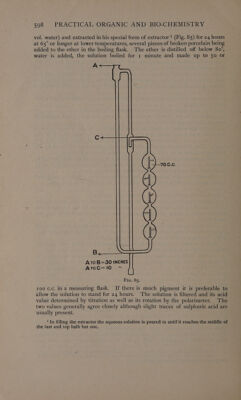
![water in a Kjeldahl flask. The distillation and oxidation is best effected by rapidly raising to the boiling-point, heating gently for 30 minutes with little or no distillate passing over and then more rapidly for 15 minutes. 80 to 125 c.c. of distillate should be obtained in this time. 2 gm. of sodium peroxide are added to the distillate and the distillation repeated until 80 c.c. have passed over in about 10-15 minutes. The second distillate is collected under ro c.c. of water in a roo c.c. measuring flask. It is diluted to 100 c.c. and mixed; 25 or 50 c.c. are removed into another flask containing 25 c.c. water, 15 c.c. of Scott-Wilson reagent are added and the mixture diluted to 100 C.c. ; At the same time ‘5 mgm. acetone are treated in the same way (see under acetone, p. 594). I mgm. acetone = 1°78 mgm. hydroxybutyric acid. Votes.—The use of sodium peroxide obviates the use of lead acetate to remove glucose, glycuronic acid, ete. . Urines containing no sugar need not be distilled twice. The distillate 1s collected in 10 c.c. of water in a I00-c.c. measuring flask and diluted to 100 C.c.; I-2 gm. of sodium peroxide are added to it and mixed with it a few times. ‘This treatment removes the disturbing substances obtained by the distillation of the urine; 25 or 50 c.c. are taken for the estimation. The estimation of hydroxybutyric acid in 1 to 5 c.c. of blood is effected by Marriott in a similar way to the general method, but using a nephelometer to estimate the acetone formed (see under acetone, p. 593). The solution after removal of the proteins could be fremted equally well by the method of Folin and Denis, and it is a little simpler to carry out. (3) Extraction with ether and estimation by rotation. 8-hydroxybutyric acid is most frequently estimated by this method; the results are affected by the presence of other substances in the extract which are also optically active, but their amounts are usually so small that they are neglected. The urine (100-300 c.c.).may be evaporated and mixed with sand or plaster to form a dry mass, which is extracted in a Soxhlet apparatus with ether, according to the description of Bergell+ or Black.” It is preferable to extract the urine which has been acidified with sulphuric acid with ether in a special extraction apparatus. (a) The urine (300-600 c.c.) is saturated with ammonium sulphate (80- go gm. per 100 c.c.), strongly acidified with sulphuric acid, and ex- tracted for 24; 48, or 72 hours in the extractor with ether according to the rate of the current of ether. The ethereal solution is filtered into a basin and the ether allowed to evaporate spontaneously or rapidly distilled off. The residue is cooled, dissolved in 5-8 c.c. of water and filtered from hippuric acid and oily products into a small measuring flask of 10 or 20 c.c. capacity. The volume is made up and the rotation determined after clearing the solution with a small quantity of ‘‘kieselguhr ” or charcoal. (2) Hurtley® treats roo c.c. urine with 40 per cent. ferric chloride solution which is run in from a burette until ferric phosphate is no longer precipitated, but an amount insufficient for the aceto-acetic acid reaction to appear ; Tooo c.c. are then treated with the proportional amount. 500 c.c. of the filtrate and the corresponding amount to half the number of c.c. of ferric chloride added are acidified with 13 c.c. of sulphuric acid (1 vol. acid + 1 1Z. Physiol. Chem., 1g01, 33, 310. 2]. Biol. Chem., 1908-9, 5, 208. 31 am much indebted to Dr. Hurtley for telling me his procedure and for much other information respecting ‘“‘ acetone”’ bodies.](https://iiif.wellcomecollection.org/image/b32769726_0617.jp2/full/800%2C/0/default.jpg)
 No text description is available for this image
 No text description is available for this image
 No text description is available for this image