Licence: Public Domain Mark
Credit: The works of John Hunter / edited by James F. Palmer. Source: Wellcome Collection.
Provider: This material has been provided by the Royal College of Physicians of Edinburgh. The original may be consulted at the Royal College of Physicians of Edinburgh.
255/678 page 225
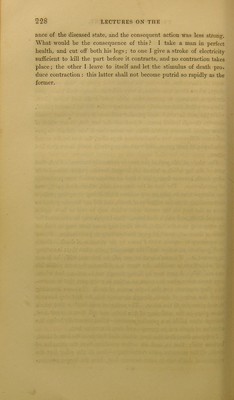
![should take place even for the preservation of the principle of action. Action is necessary for the various purposes for which the animal is in- tended, and if one species of action takes place, it brings the whole into action, as all the parts and actions of an animal body are dependent upon one another. If the heart acts, the lungs must fulfill their part; the stomach must digest, the other parts subservient to this organ must be put in motion, and the secretory organs, nerves, and voluntary muscles. The whole is thus set in motion to produce some ultimate effect, which appears to be the propagation of the species, for preservation (of the individual) cannot be called the ultimate effect. I have asserted that life simply is the principle of preservation in the animal preserving it from putrefaction; but there is a curious circum- stance attending life which would appear to be contradictory to itself. Life is the preserver of the body from putrefaction, and when life is gone putrefaction would appear soon to begin. But this is not uniform ; it is sooner in some cases than in others ; therefore there must be some other cause than the simple deprivation of life to account for this differ- ence of time. In the most striking instances of rapid putrefaction after death, it does not appear to arise from the process of putrefaction having gone to some length before total death took place, for in those who die of putrid fever the smell becomes less offensive before death, and when life is gone they do not go into putrefaction as soon as might have been expected, and not nearly so fast as many who had not the least tendency this way before death. The tendency to putrefaction in those whilst living would appear to be part of the disease, but does not become pu- trefaction, and on dying they appear to lose that tendency, and to be- come like other bodies. However, it is disputed whether, in putrid fever, there is really any putrid matter formed*. But there is a process or an action in life which predisposes the body for many diseases, and which becomes the remote cause of them; and there is an action in life which disposes the body for a species of putre- faction (or decomposition) when dead, and very probably death is the effect of this action in these cases. In these cases the body immedi- ately after death becomes emphysematous; this emphysema, though it does not occur during life, would yet appear to be an effect of life, for it depends on disease as the body is dying. It is not genuine putre- faction ; for, when the process is ended, the body keeps nearly as long as if no such process had taken place. It occurs immediately after death, or perhaps in the act of dying. The process itself seems to con- * [The offensive exhalations here alluded to may probably, in great part, be referred to the excretions, which show a great tendency to run into rapid decomposition.] VOL. 1. Q](https://iiif.wellcomecollection.org/image/b21996623_0001_0255.jp2/full/800%2C/0/default.jpg)