Licence: Public Domain Mark
Credit: The works of John Hunter / edited by James F. Palmer. Source: Wellcome Collection.
Provider: This material has been provided by the Royal College of Physicians of Edinburgh. The original may be consulted at the Royal College of Physicians of Edinburgh.
274/678 page 244
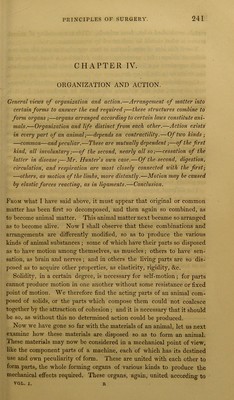
![certain degree of regularity, and according to the relationship or imme- diate necessity of the second to the first are these second permanent and constant; indeed we seldom find in them any intermission, per- haps never in health; however, in disease they are sometimes stopped. There have been instances where the motion of the heart has ceased, and also the involuntary action of breathing :—this once happened to myself. I had the gout in my feet three springs successively, and missed it the fourth. In the fifth spring, one day at ten o’clock in the forenoon, I was attacked suddenly with a pain nearly about the pylorus : it was a pain peculiar to those parts, and became so violent that I tried every position to relieve myself, but could get no ease. I then took a tea- spoonful of tincture of rhubarb, with thirty drops of laudanum, but still found no relief. As I was walking about the room, I cast my eyes on a looking-glass, and observed my countenance pale, my lips white, and I had the appearance of a dead man looking at himself. This alarmed me. I could feel no pulse in either arm. The pain still con- tinuing, I began to think it very serious. I found myself at times not breathing; and being afraid of death soon taking place if I did not breathe, I produced a voluntary action of breathing, working my lungs by the power of my will. I continued in this state three quarters of an hour, when the pain lessened, the pulse was felt, and involuntary breathing began to take place. During this state I took madeira, brandy, ginger, and other warm things; but I believe nothing did any good, as the return of health was very gradual. About two o’clock I was able to go about my business. Here, then, was a suspension of the most material involuntary actions, so much so that the involuntary action of breathing stopped, while sen- sation and all the voluntary actions were as strong as before. Quaere, What would have been the consequence if 1 had not breathed? At the time, it struck me that I should have died ; but that most proba- bly would not have been the consequence, because, most probably, breathing is only necessary for the blood when it is circulating ; but as there was no circulation going on, so no good could have arisen from breathing*. * [It is probable that the circulation, although enfeebled, still continued to be car- ried on in this case as in Lipothymia, occurring from severe and sudden injuries to vital parts. It would be contrary to every fact with which we are acquainted to sup- pose that the animal and organic functions could be executed or maintained in an active state without a due supply of fresh blood. The respiration is almost if not alto- gether suspended during the state of hybernation ; but then the animal functions, and as far as we know the organic functions also, are suspended. The same thing likewise occurs in those states which have been denominated trances and in cases of Asphyxia.]](https://iiif.wellcomecollection.org/image/b21996623_0001_0274.jp2/full/800%2C/0/default.jpg)