Licence: Public Domain Mark
Credit: The works of John Hunter / edited by James F. Palmer. Source: Wellcome Collection.
Provider: This material has been provided by the Royal College of Physicians of Edinburgh. The original may be consulted at the Royal College of Physicians of Edinburgh.
276/678 page 246
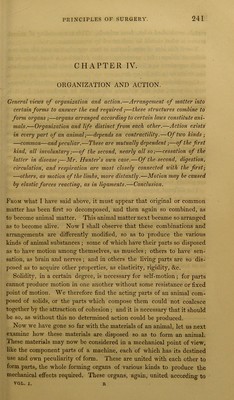
![or union of living parts organs are formed, which gives us the first mode of action, and the form of bodies gives the secondary mode. By the union of these various parts compound motion is produced. In this manner the whole of the most complicated animal machine is produced. The power of self-action which animal and vegetable matter possesses, distinguishes it from matter endued with any other properties than life, and also distinguishes living from dead matter*. * [Muscular contractility, which bears not the slightest analogy to any other power of matter, was yet frequently confounded at the time of Hunter with the principle of elasticity. Hunter was the first to show that this was never the source of actual power, like muscles, but depended on a reaction in bodies in a contrary direction to the original impressing force, and always in proportion to it. It is still, however, very difficult to refer to their true causes many of the pheno- mena presented by skin, membranes, fibrous coats, &c., which obviously contract and relax in various degrees under different conditions of the system. Most frequently these phenomena are to be accounted for upon the principle of tonicity, a power ana- logous to muscular contraction. Some, however, have been disposed to assign elasti- city as the sole cause. (See Bostock’s Phy., Vol. I. ch. iii., and Majendie’s Lect. 8—10. apud Lancet, Vol. I. 1834-5.)]](https://iiif.wellcomecollection.org/image/b21996623_0001_0276.jp2/full/800%2C/0/default.jpg)